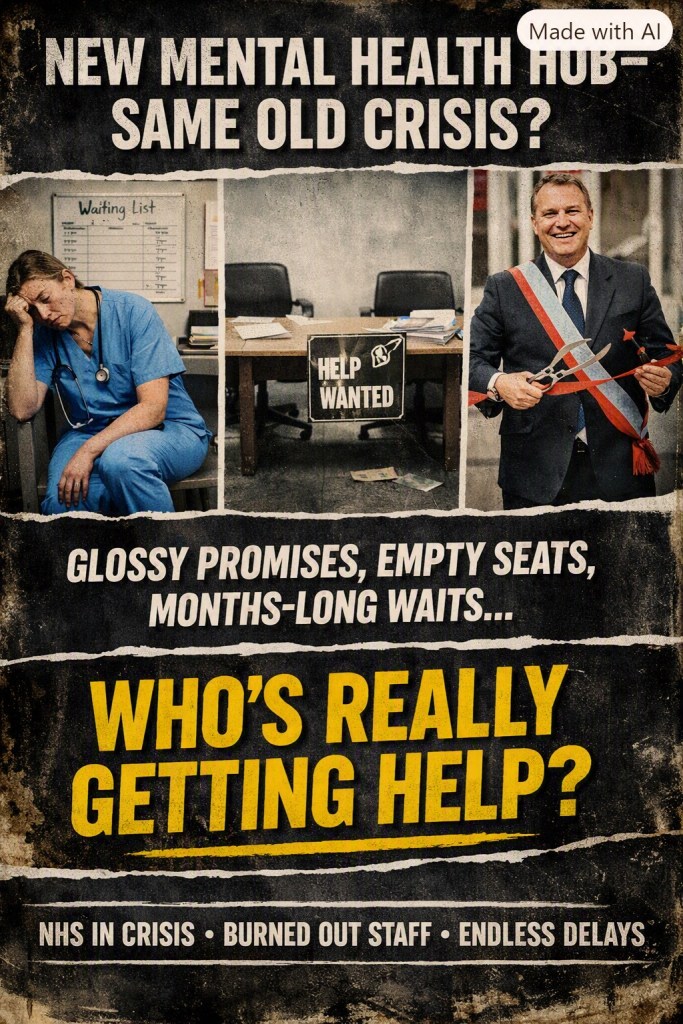
Walk‑in mental health centres are set to begin opening in libraries and banks across England from autumn 2026, marking the start of a nationwide rollout that expands further from March 2027.
England is preparing for a seismic shift in crisis care, with almost 200 walk‑in mental health hubs set to land on high streets from next year — bringing specialist support out of hospitals and directly into libraries, banks and everyday community spaces for anyone in acute distress.
The government has unveiled a sharper, high‑impact overhaul of crisis care, pledging 100 community mental health hubs and 59 specialist emergency departments to push urgent support out of overstretched hospitals and directly into local neighbourhoods.
Backed by £343m, the first centres will open in autumn 2026, with a larger wave of facilities rolling out from March 2027, marking one of the most aggressive expansions of community mental health support in decades.
The hubs are aimed at people buckling under mental health pressure but not yet at hospital doors, carving out a long‑missing frontline space for those who fall between everyday support and full‑blown emergency care.
By creating a street‑level alternative to packed A&E units, ministers say they can step in earlier, catching people’s struggles before they harden into full‑scale crisis and sparing more patients from hitting breaking point.
Some hubs will be built from scratch, while others will be carved out of existing high‑street spaces, turning everyday community buildings into rough‑and‑ready frontline posts for people who need support long before they reach breaking point.
The government says the hubs will sit “in the heart of the neighbourhoods they serve”, built to feel welcoming and non‑clinical, stripping away the sterile edge of traditional healthcare and replacing it with spaces that feel lived‑in, familiar and firmly rooted in the community.
Many of the hubs are expected to run seven days a week, with some offering short‑stay beds — giving people a safe, staffed place to steady themselves for a few nights before their situation tips into something darker.
Thousands of people are still driven into A&E at breaking point, not because it’s the right place for them, but because there’s nowhere else offering the mental health support they need before everything snaps.
The plans will add 59 new mental health emergency departments to the 23 already running, a heavy‑duty expansion of crisis units built for people who can’t afford to be left waiting in the chaos of general A&E.
Many will sit on the grounds of existing hospitals, but they’re built to offer a calmer, more therapeutic bolt‑hole, giving people in acute mental health crisis a place to steady themselves far from the fluorescent chaos and hard edges of A&E.
These specialist departments are built for people who are medically stable enough to skip general A&E, but still need same‑day mental health care, giving them a dedicated space instead of leaving them to ride out a crisis in the wrong kind of emergency room.
Together, the new centres and emergency departments will pull nurses, therapists, support workers and other teams into one tight unit, creating a more joined‑up, boots‑on‑the‑ground model of care instead of the fragmented system people in crisis are so often left to battle through alone.
However, the whole plan risks collapsing under its own weight if there aren’t enough nurses and doctors to staff it, with services already stretched thin and strikes now a regular flare‑up in a system that’s been running on fumes for years.
The idea might look polished in a ministerial press release, but without the staff to run it — and with nurses and doctors pushed to the brink and striking with grim regularity — the whole plan risks becoming yet another glossy promise built on a workforce that’s already running on empty.
It’s a brilliant idea in theory, but unless the NHS can actually find the staff to run it — in a system where nurses and doctors are already burned out, stretched thin and striking just to be heard — the whole plan risks becoming another shiny promise destined to crumble the second it hits the real world.
Right now, people with mental health needs can be left waiting months for an appointment — long enough for a crisis to deepen, long enough for someone to fall through the cracks, and long enough to make it feel like the system is watching from the sidelines while they unravel.
Right now, all you can do is watch this space and see how it unravels, because in a system already buckling under staff shortages and months‑long waits, this shiny new plan could just as easily fall apart in real time as become the miracle everyone’s praying for.
The public’s more cynical take sounds something like this: people are watching politely, nodding at the glossy promises, but deep down they’re convinced this will unravel exactly like every other “transformational” NHS plan — big talk up front, then months‑long waits, staff shortages, and a quiet admission that nothing’s really changed.


I find monthlymosquito very interesting
LikeLike