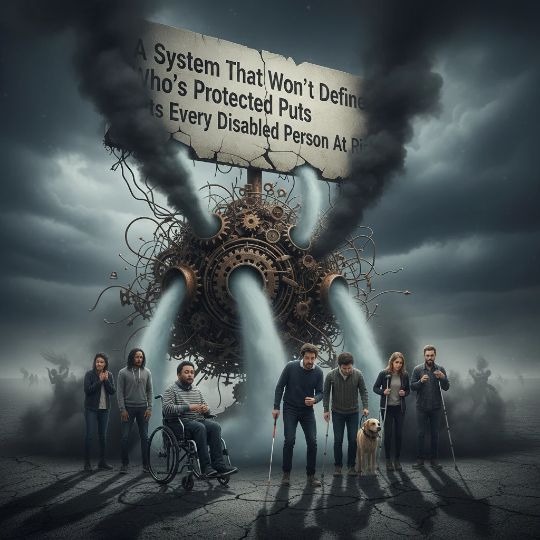
Reform UK’s welfare plan is dangerous because it creates a harsher, undefined category of “severely disabled,” leaving millions of disabled people unsure whether they would still qualify for essential support, despite evidence from the IFS that their system would be significantly harder to access and risk repeating past failures that have already caused serious harm and deaths.
When a welfare system is redesigned to narrow eligibility without clearly defining who remains protected, it creates a cliff‑edge where millions of disabled people could suddenly be recategorised as “not severe enough,” losing vital support overnight and being pushed into assessments, conditionality, and sanctions that have already been shown to cause profound harm.
Once you create a system that deliberately shrinks the definition of disability, you inevitably create a population of people who are still genuinely disabled but suddenly labelled “not disabled enough,” left to navigate harsher assessments, reduced payments, and work requirements that ignore the reality of their conditions.
Once you start stripping back unconditional support, you create a system where disabled people are forced to constantly prove and re‑prove their own suffering to sceptical assessors, turning everyday life into an exhausting cycle of justification rather than the stability and dignity they deserve.
When a government builds a system that demands constant proof of incapacity, it inevitably punishes those whose conditions fluctuate, whose symptoms are invisible, or whose disabilities don’t fit neatly into bureaucratic boxes, leaving them exposed to cuts, sanctions, and scrutiny that take a brutal toll on their health and stability.
When politicians pretend that tightening eligibility will only catch “cheats,” they ignore the reality that every past crackdown has swept up thousands of genuine disabled people, leaving them fighting for basic support. At the same time, the system insists their lived experience is somehow invalid.
Every time eligibility is tightened under the guise of “fairness,” it is disabled people with complex, misunderstood, or invisible conditions who end up paying the price, because systems built on suspicion always hit the vulnerable long before they ever touch the mythical fraudster.
Every time a government redraws the boundaries of disability, it creates fear and instability for people who already live with enough uncertainty, because the prospect of losing essential support is not an abstract policy debate but a direct threat to their health, safety, and ability to survive.
When policymakers treat disability as a narrow, easily defined category, they erase the reality that millions of people live with complex, overlapping conditions that don’t fit neat labels, leaving them vulnerable to being dismissed, downgraded, or cut off entirely by a system that no longer recognises their needs.
When public debate reduces disabled people to stereotypes or punchlines, it becomes even easier for harsh policies to slip through unchallenged, because the real human impact gets drowned out by dismissive comments from people who will never have to live with the consequences.
And people’s nasty comments only make it easier for harmful policies to take root, because when disabled people are already being mocked, doubted, or dismissed in everyday life, the system feels entitled to treat them the exact same way — with suspicion first and humanity last.

