Andy Burnham is being urged to replace council tax with a new property levy in the Budget. Would you support this change?
A shift from council tax to a modern property‑value levy would make the system fairer for lower‑value homes but significantly pricier for many London households, so support really depends on whether you prioritise regional fairness or protecting higher‑value homeowners.
Council tax is a property‑based tax, but only in a historical sense: it’s tied to what your home was worth in April 1991, placed into one of eight bands, and then charged at a flat rate set by your local authority. It does not track current market value; it does not rise or fall with real‑world prices, and it does not scale proportionally. That’s why economists describe it as regressive — lower‑value homes often pay more relative to their true value than higher‑value ones.
A modern property levy, like the one being proposed, would be a current‑value tax: updated, proportional, and directly linked to what your home is worth today. In policy terms, that’s a fundamentally different mechanism.
Any shift to a modern, current‑value property levy would almost certainly cost many people more, especially in places like London where property values have surged since 1991. Council tax is frozen in time; a new levy isn’t. That alone means a lot of households would see an increase.
Renaming council tax won’t fix anything. A fair system needs modern valuations, proportional charges, and a government that stops burning money faster than it collects it. Until waste is accountable, every “new” tax ends up costing people the same — or more.
Scrap regressive taxes like VAT, fuel duty, council tax, and replace them with a single ultra‑progressive income tax where earnings over £120,000 are taxed at 95%. That’s not a tweak — that’s a complete redesign of how the state raises money.
They change the system, shuffle the labels, make a big speech… and somehow the bill still lands on our doorstep. Any change comes with a cost, and historically that cost has a habit of rolling downhill until it hits ordinary households, not the people designing the policy.
If a government wants to overhaul how every household is taxed, it needs a mandate — not a press release.
The devil is in the detail — and right now, we don’t have the detail. Without the full numbers, thresholds, regional impacts, transition rules, and exemptions, nobody can honestly say whether this would be fair, affordable, or even workable.
Most of these calls for action aren’t coming from government at all — they’re coming from think tanks, campaign groups, commentators, and lobbyists, not elected officials.
Some say ‘if you don’t like London prices, move’ — but that ignores jobs, family, roots, responsibilities, and the fact that high costs shouldn’t be treated as a personal failing.
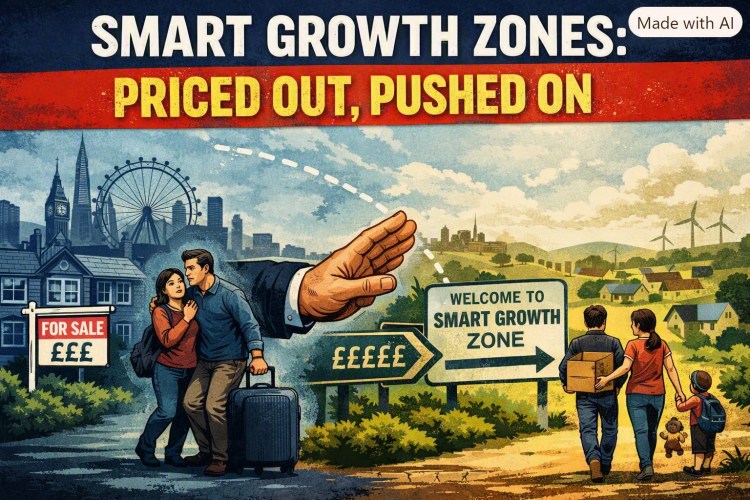
The whole idea behind some of these reforms is to nudge people out of expensive regions and ‘rebalance’ the country — not by force, but by making it financially uncomfortable to stay.
Some people fear that if policies keep nudging people out of certain regions, we’ll end up with an unofficial system where only certain groups can afford to live in certain parts of the UK.
Not that the government will formally assign people to regions — but that economic pressure becomes a quiet form of sorting.
People won’t be told to move — they’ll be pushed. That’s not a mandate, that’s not democratic, that’s not transparent. It’s economic pressure being used to shape where people live.
They won’t tell people to move — they’ll push them. And they’ll dress it up with a friendly name like ‘smart growth zones’ to make engineered population shifts sound like urban planning, and some people worry that once they start using cost pressure to push people around the map, the next step is dressing it up with a planning term like ‘smart growth zones’ — and that it signals a shift that could come to the UK sooner than people realise.

