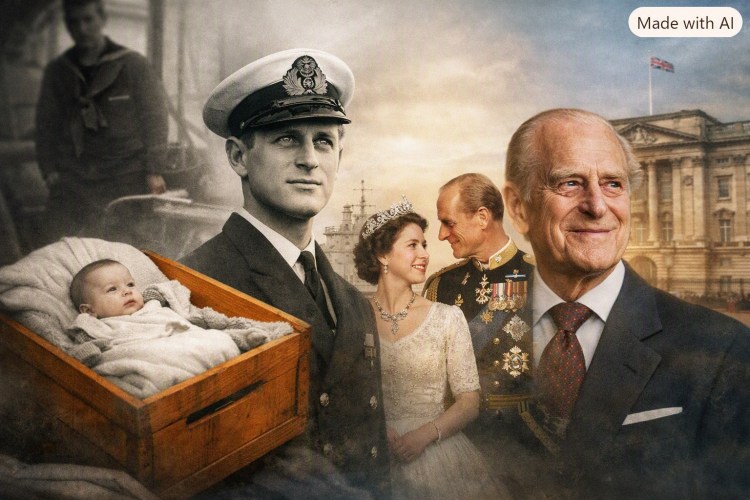
He began life in an orange box on a warship and ended it as a man who reshaped a kingdom.
Shuffled across Europe while his mother lived in a sanatorium and his father fled to the Riviera, he grew up making a home out of whatever country would have him, until England finally did.
He forged himself into a determined young man, becoming head boy at Gordonstoun before joining the Royal Navy at eighteen and earning a wartime mention in dispatches for his actions at Cape Matapan.
Then his life turned again, as he surrendered his Greek and Danish titles, became a British citizen, and married Princess Elizabeth in 1947.
Five years later, she became Queen, and Philip found himself married to Britain’s most important woman while holding almost no formal power, spending years without a title of his own and walking several steps behind her by protocol.
He accepted it, but then after, for seventy‑three years, he stood beside her.
He undertook more than 22,000 official engagements, delivered thousands of speeches, supported hundreds of organisations, and created the Duke of Edinburgh’s Award, which ultimately reached millions of young people worldwide.
He died at Windsor Castle on April 9, 2021, just two months shy of his hundredth birthday, and the Queen, who once called him her “strength and stay,” mourned the man who had stood beside her for a lifetime.
Perhaps that says more about his life than any title ever could: born on this day in 1921, Prince Philip — a boy who began life in an orange box, lost almost everything familiar, and somehow became a man who spent nearly a century standing beside a queen.
No wonder he had such a dry sense of humour, given a life that left him parched long before the jokes ever did.
Prince Philip was a man shaped by displacement, hardened by duty, softened by loyalty, and sharpened by a sense of humour dry enough to crack stone.
The Queen and Prince Philip came from profoundly different backgrounds, one shaped by sheltered stability and the other by exile and upheaval.
Their marriage survived because loyalty, duty, humour, and sheer stubborn commitment bound two utterly different people into a partnership that neither fame nor fate could break.
They loved one another — not loudly, not theatrically, but with loyalty, respect, humour, and a kind of mutual reliance that deepened over decades.
There has never been verified evidence that Prince Philip had affairs. Rumours followed him for decades — because he was charismatic, social, often away on engagements, and the press loves a royal scandal — but none of the claims was ever substantiated, and every person named in those stories publicly denied them.
He also created the World Wide Fund to protect nature, adding conservation to a life already defined by duty, service, and restless purpose.
He fought for Britain even as his sisters’ husbands were tied to the Nazi regime, a decent man shaped by loyalty and duty, and it’s little wonder he felt abandoned when the chaos of his fractured European family left him largely on his own.
He fulfilled his role brilliantly; the Queen could not have asked for a better consort, and though he held no formal power, she trusted his judgement so deeply that his perspective quietly shaped much of her reign.
He gave up so much to marry the Queen, stepping out of a world where he’d always been the boss into a role with no power at all, and though it must have been difficult, he accepted it because he loved her.
Very capable and restless, with a dry, amusing sense of humour, he was a man who marched to his own beat for most of his life.

