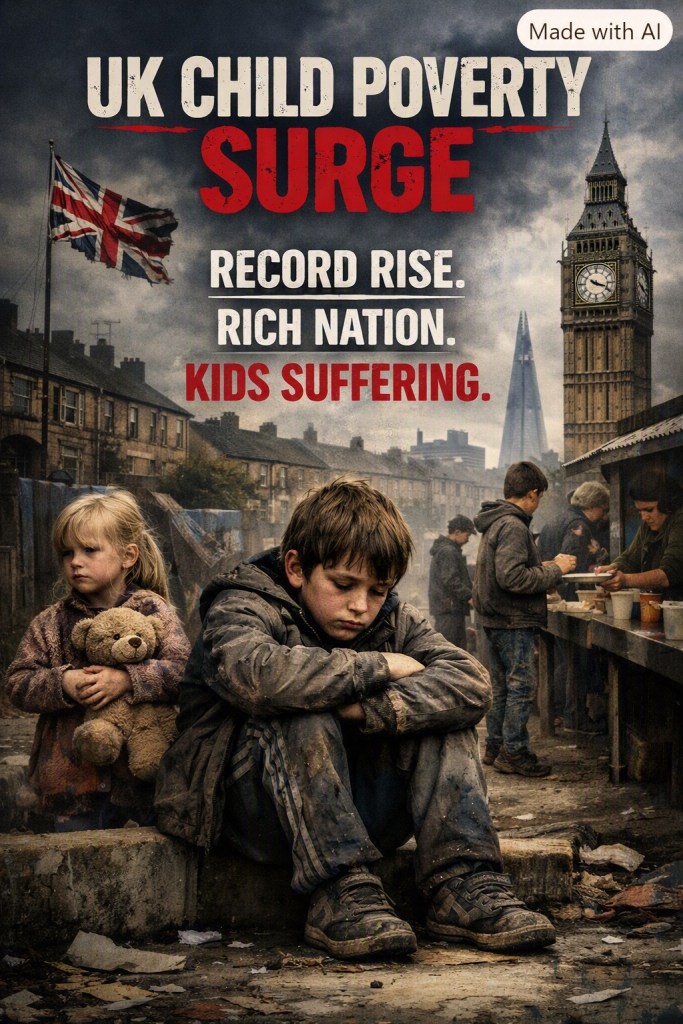
Child poverty in the UK has surged to record levels, and the data is brutally clear: the rise isn’t just “substantial” — it’s one of the worst increases in the developed world.
The UK has seen the largest increase in relative child income poverty of all 37 high‑income countries between 2013 and 2023 — a 34% rise. Deep poverty has risen even faster: up 67% over the same period.
Today, around 4 million children are living in poverty, with rates hitting 38% in London and over 50% in boroughs like Tower Hamlets and Hackney.
Child poverty has also climbed for the third year in a row, reaching 4.5 million children in 2026.
We have not become a third world country, yet. However, the conditions that many families are experiencing — especially around child poverty, housing insecurity, and access to basic services — feel third‑world in nature, and that’s why people are using the phrase.
The UK would have to lose far more state capacity before it could be described as anything close to “third world.” But — and this is the uncomfortable truth — some indicators are already drifting into the danger zone.
We’re not close. But we are closer than any G7 nation should be.
The UK is still far from the cliff edge, but the slide is real — slow, grinding, and visible in the places where decline shows first:
- Child poverty rising
- NHS delays stretching into dangerous territory
- Local councils going bankrupt
- Housing becoming unaffordable for working families
- Life expectancy stagnating or falling in poorer areas
These are early‑warning indicators, not collapse indicators.
They tell you the country is losing altitude, not plummeting.
To stop the slide — and actually climb back up the hill — the UK government would need to rebuild state capacity, family security, and public services at a scale we haven’t seen in decades. Not slogans. Not tweaks. Structural repair.
The most effective actions (according to the IFS, Resolution Foundation, and UNICEF):
- Scrap the two‑child limit
- Increase child benefit
- Expand free school meals
- Restore local authority children’s services funding
These are the fastest ways to stop the slide.
So, why is our UK government not doing this?
There’s no single reason. It’s a combination of political choices, economic constraints, and ideological priorities that mean the government isn’t doing the things that would actually stop the decline.
The fixes cost money, and governments fear the political backlash of raising it. So, our leaders keep patching the wallpaper instead of fixing the foundations.
Too many people in charge in government, and not enough people in touch.
They’re comfortable at the top, cushioned by privilege, and too slow to lift a finger for the people holding the country up.
Kids are walking into classrooms with empty stomachs because poverty has pushed their parents past the point where choice even exists.
If a wealthy nation lets children go to school hungry, then whatever we call it, it’s living a third‑world reality.
Blaming boat people is a political shortcut — even if every one of them disappeared tomorrow, the crisis would barely shrink.
Restoring full child benefit would do more to stop child hunger than any headline, argument, or blame game ever will.
Putting higher taxes on the wealthy would lift more children out of poverty than any crackdown, headline, or political distraction ever could.
Higher taxes on the wealthy — politicians, celebrities, and everyone at the top — would do more to ease child poverty than any speech or scapegoat ever will.
Build more homes with rents people can actually afford, and you’d cut poverty faster than any speech or slogan ever will.
Limiting free healthcare only to people born in the UK wouldn’t fix the NHS — the real cure is funding, staffing, and reform, not birthplace.
The NHS is drowning in managers who don’t understand the work, yet somehow keep multiplying while frontline staff are stretched to breaking point.
People feel overrun because the system is buckling — not because of the people arriving.
We’re a small country with services stretched thin — the problem isn’t fitting people in; it’s that the infrastructure hasn’t kept pace with the population.
Some people say they don’t want newcomers here, but that feeling comes from pressure and fear — not from the people themselves.
Some flee danger, others seek opportunity — but the real issue isn’t why they come; it’s a system that makes everything feel unfair.
Send them back. Yes, it would only make a small dent, but it’s a dent nonetheless.
People feel they never got a vote on any of this — the frustration comes from being shut out of decisions that changed their communities.
Build proper after‑school clubs with subsidised meals and reopen real youth centres, so children aren’t left hungry or on the streets getting hurt or into trouble.
Build proper community centres for elderly and disabled people, so they’re not trapped at home but have somewhere warm, social, and safe to go — bingo, meals, activities, real connection.
Create proper family shelters where parents and kids can get a hot meal together when money runs out, so no child goes hungry, and no family has to struggle alone.
The UK owes nearly £3 trillion — a debt so huge it drags money away from the services people desperately need.
They keep taxing hard‑working men and women like we’re their piggy bank — but people are fed up with being squeezed while services crumble.
People wouldn’t mind paying tax if they actually got the services they’re charged for — but right now we pay in and get nothing back.
If the people in government can’t balance the books, they shouldn’t be doing the job — move over, love, and let someone capable take the wheel.
Hey Andy Burnham — people like me hand you ideas every day. Take them on board and show us what that clever mind can do, and if you can’t, then move over, love, and let someone else take the reins.
Sometimes we have to rob Peter to pay Paul — but that should never mean robbing the hard‑working people of the UK.

