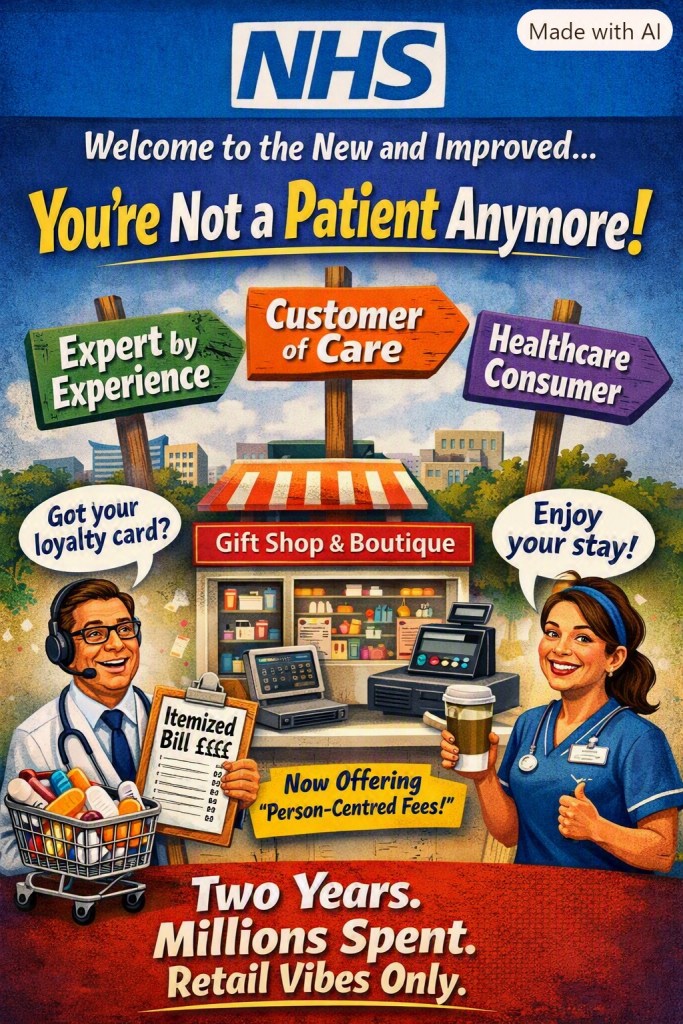
This NHS trust no longer wants to call you a patient.
Sussex Health & Care, after a two‑year, taxpayer‑funded review, has formally advised staff to stop calling people patients and instead use terms like “experts by experience,” “customers,” or “consumers.”
Congratulations: you’re no longer a patient — you’re an expert by experience being warm‑handed over by a non‑disabled person who insists you were never hard to reach, just tragically under‑served.
The NHS used to call you a patient — someone getting actual medical care — but Sussex Health & Care now prefers a selection box of vague alternatives, as if clarity itself has become clinically unsafe.
This NHS language guide has suddenly gone viral — mostly because people online have decided it’s so silly and confusing that it reads like the NHS tried to rebrand patients using a thesaurus and a blindfold.
Instead of calling someone a patient, the guide suggests rebranding them as a ‘service leader’, ‘expert by experience’, ‘consumer’, or — if all else fails — simply ‘a person with a mental illness’, as though the NHS pulled these options from a hat labelled Words That Sound Like They Mean Something.
The guide basically says: ‘Don’t worry, these aren’t rules — just a gentle nudge to rethink your language,’ which is NHS‑speak for we’re not forcing you, but we absolutely are watching to see if you comply.
The guide claims these new terms will make things ‘clearer’ and more ‘person‑centred’, which is adorable, because nothing says clarity like replacing ‘patient’ with four different job titles and a vibes‑based identity.
But social media wasn’t having it — one YouTube commenter said the poor patient would need an interpreter just to understand the ‘new language’, which is honestly the most NHS‑adjacent plot twist imaginable.
Others online weren’t any kinder — one called it ‘a little silly’, while another went straight for ‘utter drivel’, proving the guide has achieved the rare honour of uniting the internet in collective eye‑rolling.
And the professionals aren’t convinced either — Dr Lucy Hooper and Dr Ali Ross both say this language makeover does absolutely nothing for people trying to get medical help, which is the polite clinical way of saying: this helps no one; please put the thesaurus down.
Dr Hooper told Metro she doesn’t think ‘patient’ is such an awful word — after all, every one of us will be a patient at some point — which is her polite way of saying: why are we reinventing a perfectly normal word that already works?
They’re wasting effort on things that don’t matter — polishing vocabulary while the actual care sits in the corner like, ‘Hello? Anyone going to focus on me?”
Honestly, instead of hunting down the manager who dreamed this up and sacking them, we should just gently escort them to a quiet room, hand them a cup of tea, and ask them to stop weaponising the thesaurus.
Soon you won’t be a patient at all — you’ll be a ‘customer’ or ‘client’, neatly rebranded just in time for them to send you an itemised bill and call it ‘person‑centred finance.’
Patients are not customers, not clients, not service users, not consumers — they’re patients, and no amount of linguistic origami is going to turn a hospital ward into a branch of Customer Services.

