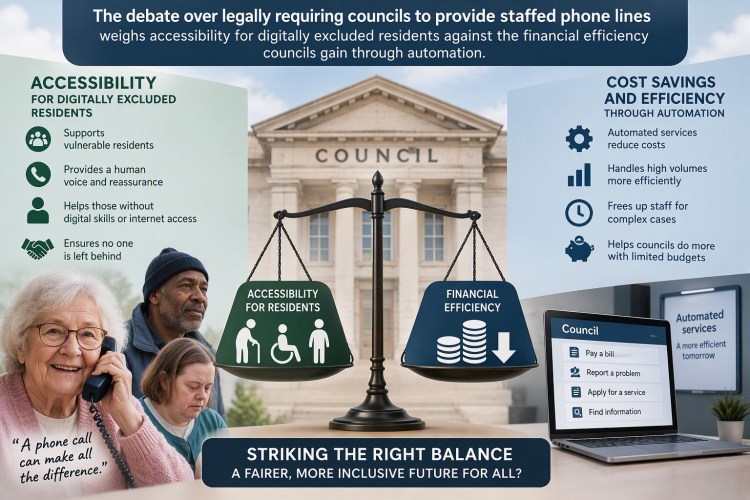
The debate over legally requiring councils to provide staffed phone lines weighs accessibility for digitally excluded residents against the financial efficiency councils gain through automation.
While councils face a severe £7 billion funding black hole that forces them to automate phone lines, national campaigns and regional coalitions are pushing for mandatory digital exclusion strategies to protect offline access for vulnerable residents.
While official parliamentary campaigns like the “right to live offline” petition have recently closed, active initiatives like the Age UK “Offline and Overlooked” campaign and open healthcare petitions continue to fight for legally protected offline access to public services.
While residents have a democratic right to vote out local representatives who they feel fail to serve them by cutting off telephone support, councils argue that they must prioritise funding statutory frontline services over administrative contact channels to balance their budgets.
While critics argue that eliminating manned telephone lines violates the Equality Act 2010 by failing to provide reasonable adjustments for those with disabilities, mental health conditions, or financial hardships, councils contend that they meet their legal duties through targeted alternatives like library-based digital hubs and face-to-face appointments.
While police forces argue that replacing physical front counters with outsourced services like the Report Fraud system saves vital funds for frontline officers, critics contend that forcing distressed crime victims onto websites and automated lines destroys the essential trust of community-led policing.
While frustrated residents argue that defensive call handlers use hostile screening tactics to deflect reports and blame the victim, public service organisations contend that staff must remain strictly objective and analytical to clarify legal liabilities within high-pressure, standardised protocols.
You can access free, empathetic advocacy through independent charities like Victim Support (by calling 0808 1689 111) or the London Victim and Witness Service (by calling 0808 168 9291), both of which will stand by your side and ensure your voice is heard without judgement.
While frustrated residents argue that withholding council tax is a justified response when public services refuse to provide telephone communication, local authorities stress that council tax is a mandatory statutory obligation under the Local Government Finance Act 1992, meaning non-payment is a criminal offence that triggers immediate court action regardless of service quality.
Because Council Tax is a statutory tax enacted by Parliament under the Local Government Finance Act 1992 and not a private contract, residents are legally obligated to pay it regardless of the council’s performance, meaning it cannot be lawfully withheld due to poor customer service.
While critics argue that Council Tax is poor value because rising bills coincide with a visible decline in street-level services like pothole repairs, supporters contend it is vital value for money because it acts as a collective safety net, funding essential, high-cost social care for the community’s most vulnerable residents.
While frustrated residents argue that council staff use cold, dismissive tactics to deflect complaints and avoid accountability, public service advocates contend that what appears as rudeness is often a result of overwhelmed workers facing extreme stress, unmanageable workloads, and strict processing protocols driven by a £7 billion funding black hole.
While critics argue that dissatisfied council workers should seek alternative employment if they cannot provide respectful public service, labour market analysts contend that encouraging staff to quit would worsen a severe public sector retention crisis, causing already overstretched local services to deteriorate further.
However, no resident deserves to be treated with disrespect when accessing essential public services, and council employees have a clear professional obligation to maintain courtesy and standard customer service regardless of their internal budget or workload pressures.
Under the Immigration Act 2016, public-facing workers must possess the necessary command of English to perform their role, but this legal definition of fluency allows for diverse accents and does not require staff to speak with a specific regional dialect. When public services outsource their call centres to external private companies—either within different regions of the UK or internationally—background noise from busy call floors and compressed telephone lines can heavily distort speech, making it incredibly difficult for callers to comprehend the conversation.
If an insurmountable communication barrier occurs because you cannot understand a staff member’s accent, you have the right to request that they slow down, repeat the information, or transfer you to a supervisor, and you can formally demand a written follow-up via email under public accessibility guidelines.

