On 20 April 1968, British politician Enoch Powell gave a famous speech in Birmingham that strongly warned against large-scale immigration.
While Powell was removed from the Shadow Cabinet the next day, he remained an elected MP and continued to speak publicly.
Five decades later, Powell’s legacy remains highly polarising, as people still debate whether his warnings were prescient or harmful.
Whether Powell was correct remains a highly divisive question, as supporters argue his warnings about demographic changes were prescient, while critics point out that his predictions of violent racial subjugation and total civil war never came to pass.
While supporters believe listening to Powell would have prevented modern social and demographic strains, critics argue his policies would have ruined Britain’s post-war economy and created deep state-sponsored divisions.
Some people believe Powell’s demographic warnings have been proven right; others argue that his predictions of a violent takeover were incorrect and that multi-ethnic diversity has successfully integrated into modern British society.
Supporters view Powell’s speech as a courageous act of foresight that predicted today’s demographic realities; critics condemn it as a divisive gamble that weaponised racial fears and made inaccurate, apocalyptic predictions.
While supporters believe Powell’s demographic predictions showed unique foresight that would have made him an exceptional Prime Minister, critics argue his catastrophic warnings were incorrect, and his divisive rhetoric would have made him an ungovernable leader.
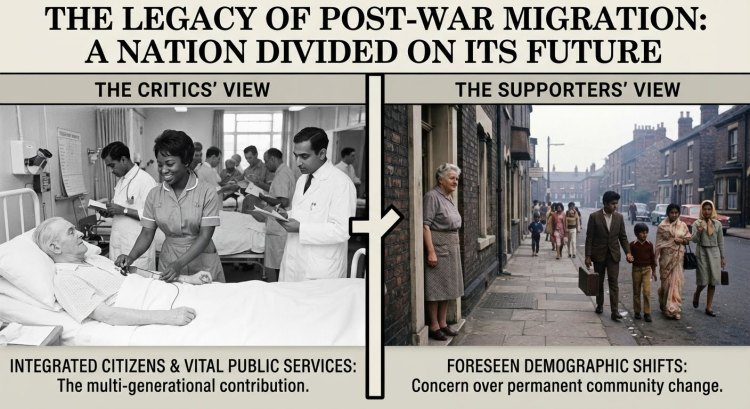
Critics emphasise that Powell actively recruited Commonwealth doctors and nurses as Minister of Health from 1960 to 1963; his defenders argue these initiatives were intended for skilled, temporary professional labour rather than permanent mass settlement.
While critics point out that the children of those recruited workers grew up as integrated British citizens who fundamentally sustained the nation’s economy and public services, supporters argue that governments failed to foresee how temporary economic recruitment would lead to permanent demographic shifts.
Many individuals feel that their families’ historic anxieties about demographic changes have been validated by their personal experiences; others view the multi-generational evolution of a diverse Britain as a positive and integral part of modern national identity.
Some people view the ongoing social and political friction around immigration as validation of Powell’s warnings of future conflict; others argue that Britain’s functioning multi-ethnic democracy disproves his apocalyptic predictions.
While supporters honour Powell as a visionary and truthful politician who sacrificed his career to voice public concerns, critics reject this view, arguing he was justly penalised for delivering an inflammatory speech that weaponised racial fears and damaged social cohesion.

