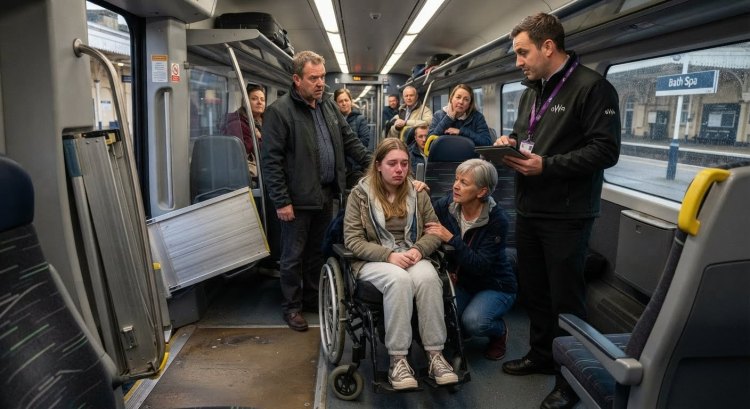
In December 2025, 24-year-old wheelchair user Phoebe Tesoriere was left in tears after being forced to crawl through three Great Western Railway carriages on her hands and knees to exit at Bath Spa station when staff failed to provide a ramp.
Despite the Paddington assistance desk assuring her that a ramp would be waiting, Phoebe Tesoriere had no choice but to crawl through three carriages to exit at Bath Spa because her wheelchair-accessible carriage stopped past the end of the platform.
Great Western Railway (GWR) issued a formal apology admitting they completely “let her down, both when we helped her board and at several points during her journey”. At the same time, internal emails later revealed that management deemed the distressing incident “entirely avoidable” and acknowledged that she should have been able to travel with confidence and dignity.
Following a five-month investigation that concluded in May 2026, Great Western Railway (GWR) formally admitted Phoebe Tesoriere’s experience was “extremely poor” and promised compensation, yet by October 2026 they had ignored all her follow-up emails for months, leaving her in an ongoing battle to receive the payout nearly nine months after the initial trauma.
After years of being misdiagnosed with anxiety and depression by doctors who dismissed her worsening symptoms—even after a seizure left her in a three-day coma—Phoebe Tesoriere used ChatGPT to input her medical history, which accurately flagged Hereditary Spastic Paraplegia (HSP), a rare, progressive neurodegenerative disorder affecting all four limbs that was officially confirmed through later genetic testing.
While the NHS strictly warns against using unregulated tools like ChatGPT due to data privacy risks and the danger of medical hallucinations, the health service is actively rolling out its own officially vetted, clinically validated AI triage systems within the NHS App to safely guide patients to the correct point of care while ensuring a human professional always reviews the final clinical decision.
While primary care doctors initially worry about “cyberchondria” and the dangers of AI hallucinations, many are increasingly embracing ChatGPT printouts as valuable conversational tools that help patients articulate complex symptoms, provided a qualified human professional is ultimately used to interpret and validate the findings.
Inputting personal medical symptoms into commercial AI tools carries major data privacy risks because consumer chatbots operate outside the strict legal protections of patient-doctor confidentiality, routinely store sensitive health data on corporate cloud servers, and use your private prompts to train their models unless you manually opt out of their data collection and tracking.
To stop OpenAI from using your personal medical symptoms to train its algorithms, you can protect your privacy on desktop or mobile by navigating to Settings, selecting Data Controls, and toggling off the Chat History & Training switch, which prevents future conversations from being saved to your sidebar or used for model refinement.

