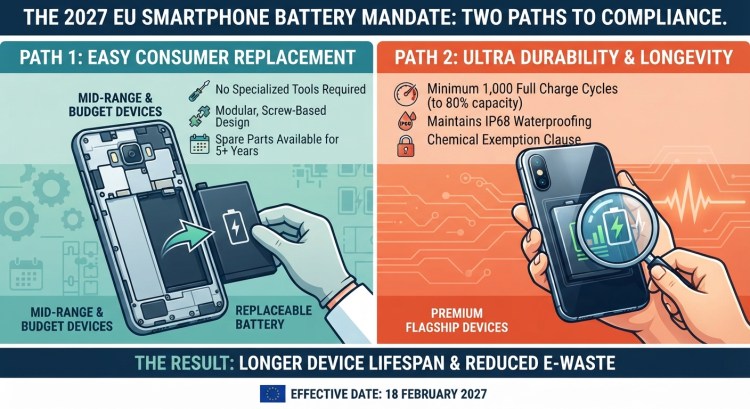
Starting on 18 February 2027, the EU will require all mobile phones to feature consumer-replaceable batteries easily or meet significantly higher durability and lifespan standards.
While major tech giants like Apple and Samsung aim to bypass the physical removability rule for their premium flagships by building ultra-durable batteries that maintain 80% health over 1,000 cycles, the 2027 EU regulation will ultimately force budget and mid-range devices to abandon permanent chemical glues in favour of reusable rubber gaskets and screws, proving that consumer-replaceable designs can successfully coexist with robust IP68 waterproofing despite making phones slightly thicker.
Although the upfront price of budget smartphones may increase slightly by £10 to £20 to cover the cost of complex mechanical seals or premium battery chemistry, this short-term expense will be heavily outweighed by long-term consumer savings and massive environmental benefits, as easy battery replacements will prevent functional devices from being prematurely thrown into landfills, cut down on carbon-intensive manufacturing, and trigger strict EU-mandated recycling targets to recover up to 90% of precious raw materials like cobalt and copper.
By scanning a QR code, the EU’s newly mandated Digital Battery Passport will allow consumers and recyclers to instantly trace a battery’s full carbon footprint and material composition, while global alignment intensifies as individual US states pass aggressive local legislation and the UK prepares to enforce its own strict smartphone Right to Repair laws on 1 July 2027.
By standardising hardware architecture globally to comply with these overlapping international regulations, device manufacturers are embedding a permanent QR code on every smartphone that links to the EU’s 71-point Digital Battery Passport registry, allowing consumers and commercial recyclers to instantly audit static engineering specs, real-time battery health degradation metrics, and supply-chain due diligence data over the device’s entire lifecycle.
By populating specific data fields detailing exact chemical composition, cell weight, and hazardous material presence, the Digital Battery Passport allows industrial recycling facilities to deploy high-speed optical scanners that instantly read the device’s QR code to mechanically categorise, sort, and process spent batteries with maximum recovery efficiency.
By utilising a multi-layered security structure that partitions data, the Digital Battery Passport restricts highly sensitive engineering specifications to a secure access layer reserved for verified regulators and certified recycling facilities, while simultaneously exposing general material metrics via a public QR code that AI-driven robotic sorting arms scan to automatically process up to 2.4 tons of spent batteries per hour on high-speed conveyor belts without compromising manufacturer trade secrets.
While many tech enthusiasts celebrate the 2027 regulations for effortlessly doubling a device’s lifespan and reducing e-waste, hardware engineers and casual consumers express strong concerns that eliminating chemical adhesives will make waterproofing sensitive electronics significantly more difficult, leading to bulkier designs and higher manufacturing costs.

