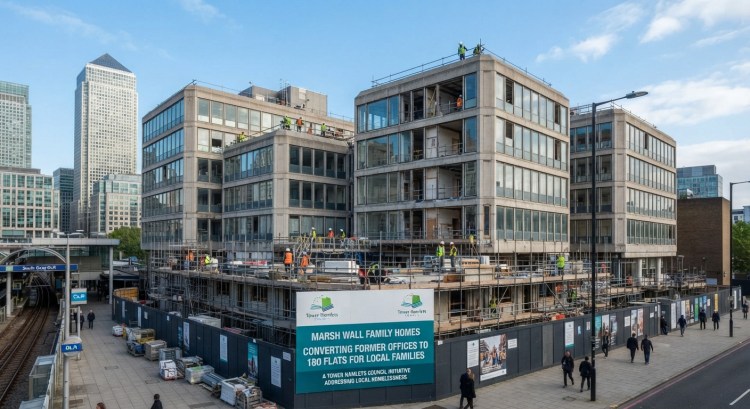
Tower Hamlets Council has approved the 10-year lease and conversion of four office buildings at 191, 193, 195, and 197 Marsh Wall in Canary Wharf into roughly 180 self-contained two- and three-bedroom temporary accommodation flats, a move driven by an 11% year-on-year surge in local homelessness that has left over 3,100 households displaced, aiming to bring vulnerable families back closer to their schools and communities despite the project carrying undisclosed financial risks and operating at a net cost to the borough.
Emphasising the project’s human impact, Executive Mayor Lutfur Rahman stated that every family deserves a safe, secure home close to their schools and support networks, explaining that transforming the former Lyca Mobile headquarters at Thames Quay into 180 family-sized units provides a critical opportunity to bring vulnerable residents back into the borough while simultaneously reducing Tower Hamlets’ long-term reliance on expensive, nightly-paid emergency accommodation.
Governed by Permitted Development Rights (PDR), these fast-track conversions bypass traditional full planning applications to allow developers to rapidly repurpose commercial properties, provided they meet strict statutory requirements, including the provision of adequate natural light in all habitable rooms, compliance with nationwide internal space standards, and rigorous fire safety testing to guarantee the safety of multi-family residential structures.
While retrofitting an existing concrete frame saves significant embodied carbon and up to 35% in construction costs compared to a full demolition and rebuild, developers must still invest heavily to meet stringent high-rise residential regulations, which mandate the costly retrospective installation of automatic sprinkler systems, secondary protected escape stairs, and compartmented fire-stopping materials between floors.
Local authorities can actively offset the high upfront costs of these vital energy efficiency upgrades by blending public sector finance from the London RE: FIT Programme with innovative private funding mechanisms like Retrofit Credits, which monetise verified carbon reductions in social housing to attract corporate ESG capital.
To successfully qualify for these restrictive financial grants, the council must ensure that the Marsh Wall office conversion comprehensively hits a minimum Energy Performance Certificate (EPC) rating of B, an ambitious target that requires a substantial structural overhaul of the building’s existing commercial facades through the installation of high-efficiency triple glazing, external wall insulation, and modern heat pump systems to replace legacy corporate gas boilers.
While an initial capital expenditure of up to £30,000 per flat presents a substantial upfront financial hurdle for local authorities, these comprehensive deep-retrofit upgrades can ultimately deliver a 60% reduction in tenant energy bills and slash the building’s long-term operational costs, effectively mitigating a significant portion of the borough’s ongoing financial liability over the duration of the 10-year lease.
Public reactions to the Marsh Wall conversion are highly polarised, with supportive residents praising the council for reclaiming empty commercial spaces to bring vulnerable local families back from distant out-of-borough placements like Kent and Essex, while critics argue that over-concentrating high-density temporary housing in one of the UK’s most overcrowded boroughs will severely aggravate local infrastructure strain and ignore single homeless individuals who are left out of the family-focused allocation.
Local community groups argue that injecting 180 high-density family households into the Isle of Dogs will push the area’s severely overstretched infrastructure past a breaking point, explicitly pointing to years of underfunded GP surgeries, crowded public transport networks, and a historic lack of dedicated green spaces and child play areas as clear evidence that the local civic landscape cannot safely absorb sudden population spikes.

