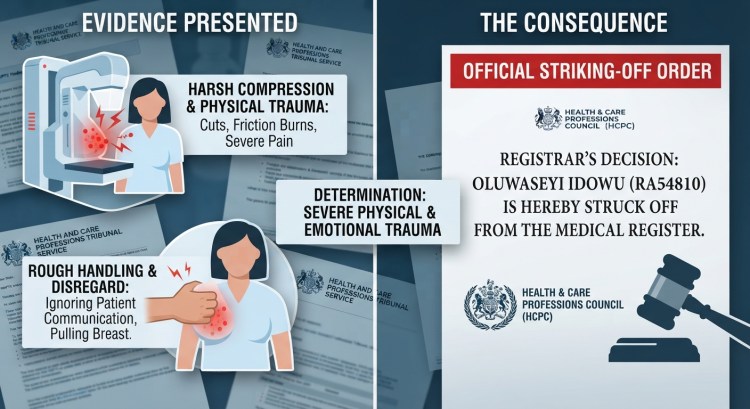
Oluwaseyi Idowu, an NHS radiographer, has been officially struck off the medical register following a Health and Care Professions Tribunal Service hearing which determined she caused severe physical and emotional trauma by ignoring patient communication, roughly pulling a disabled patient’s breast, and compressing another patient’s breasts so harshly in a mammogram machine that it resulted in cuts, friction burns, and severe pain.
After multiple reports were made about her aggressive conduct toward service users at the Nottingham Breast Institute, Oluwaseyi Idowu was struck off the medical register by the Health & Care Professions Tribunal Service (HCPTS) because the panel concluded that her persistent lack of empathy, rough handling of patients during mammograms, and complete absence of insight made a striking-off order the only appropriate sanction to ensure public safety and maintain professional standards.
During the misconduct hearing, the tribunal panel heard that Ms Idowu grabbed and pulled a patient’s breast with her fingers, an aggressive action that caused the service user significant pain and distress while leaving visible white marks on her skin that led a witnessing colleague to state the patient had been severely “manhandled”.
Another patient reported suffering cuts, friction burns, and severe pain during a procedure because Ms Idowu failed to release the pressure of the clamps, choosing instead to push and prod the patient while commanding her to relax in a hostile tone.
A third patient, known as Patient A, testified that Ms Idowu compressed her breasts in the machine on three separate occasions without obtaining an image, subjecting her to heavy-handed, painful clamping that sent shooting pains down her neck and left her deeply upset and tearful.
Patient A emphasised that “no other mammographer had ever carried out the procedure in the manner [Ms Idowu] did,” highlighting how the radiographer’s uniquely aggressive approach stood out as completely unprofessional and painful compared to all her previous breast screenings.
Other patients described similar experiences of intense pain caused by her harsh treatment, with one service user stating she “felt like a piece of meat” due to Ms Idowu’s rough handling and dismissive attitude during the screenings.
Many patients share that sentiment, as breast screening is inherently uncomfortable and anxiety-inducing even under the best clinical circumstances, which is exactly why the tribunal panel found Ms Idowu’s rough and unempathetic handling to be such a severe breach of professional duty.
Cases of clinical cruelty like this risk deterring women from attending life-saving breast screenings, as a single widely publicised report of rough and unempathetic handling can amplify existing fears and dangerously erode public trust in the entire screening programme.
While public records do not show a separate formal apology statement from the Trust regarding the tribunal, Nottingham University Hospitals NHS Trust relied on its internal safety reporting and staff testimonies to suspend Ms Idowu immediately and escalate her case to the regulators to ensure patient safety.
Public reactions and comments regarding the case predominantly reflect deep anxiety over the validation of mammogram fears alongside widespread relief that the regulator took action, with many women using online spaces to condemn Ms Idowu’s harsh treatment while simultaneously sharing their own positive experiences to reassure others not to avoid life-saving screenings.

