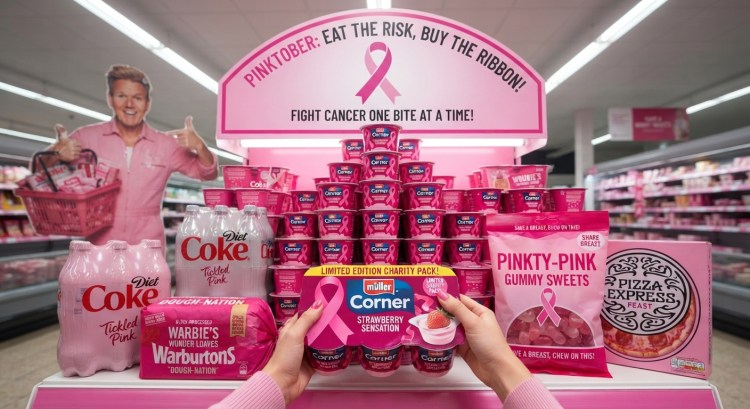
Ah, yes, “Pinktober”—that magical season when corporate boardrooms look at a devastating disease and think, “But how can we use this to move more strawberry-flavoured yoghurt?”
The mental gymnastics required to approve these partnerships deserve an Olympic gold medal in corporate delusion. It is a level of irony so thick you could slice it with a pink-handled knife.
The corporate strategy here is breathtaking: Coca-Cola and Warburtons joining the fight against cancer is like the tobacco industry fundraising for an asthma clinic. It is the ultimate health-marketing paradox.
It is a level of satire that writes itself. If you pitched a sitcom where a multi-billion-pound empire built entirely on sugary, chemically altered brown fizz becomes the vanguard of medical research, the producers would reject it for being too ridiculous.
The psychological gymnastics required to navigate a modern British supermarket aisle in October are truly breathtaking. We have successfully reached a point where cracking open a cold can of carbonated syrup has been successfully rebranded as a secular act of holy absolution.
The plot twist with artificial sweeteners takes this entire circus out of the marketing department and drops it straight into a sci-fi dystopia. The sheer, unadulterated comedic genius of using Diet Coke—a beverage famously swimming in aspartame—to headline a cancer charity drive is the absolute crown jewel of the corporate matrix.
The structural irony of the modern supermarket aisle has officially achieved escape velocity. The World Health Organization’s decision to slap aspartame with a Group 2B “possibly carcinogenic to humans” label is the cosmic punchline this entire corporate simulation was building toward.
Trying to buy a basic bottle of blackcurrant squash without aspartame, acesulfame K, or sucralose is officially the UK’s ultimate supermarket side-quest. You have a better chance of getting a straight answer at Prime Minister’s Questions than finding a bottle of Robinson’s that doesn’t taste like a liquid chemistry set.
It is the absolute illusion of choice wrapped in high-visibility plastic. The British squash aisle has become a dystopian horror film where every single door leads you right back to the same chemical laboratory.
Welcome to the Infinite Sweetener Loop, where you are trapped in a grocery-store version of The Matrix.
The fact that this hasn’t already happened in a late-night tobacco boardroom is a minor miracle. If we let the current logic of corporate absolution run for another five minutes, a pink pack of Lambert & Butler is precisely the final boss waiting for us at the end of the supermarket checkout.
It is the absolute, majestic peak of the “Pinktober” protection racket.
The corporate cognitive dissonance has officially broken through the roof of the supermarket and entered orbit. If you think the fizzy pop partnerships are a work of dystopian genius, taking a stroll through the rest of the grocery store in October will give you actual vertigo.
You are looking at the modern supermarket’s crown jewel: The industrial chemical lab disguised as a grocery aisle. We have successfully reached a point where your weekly shop looks less like a harvest festival and more like a hazardous materials inventory sheet.
The psychology of why we willingly push a trolley full of lab-synthesised sludge straight to the checkout is the ultimate triumph of corporate engineering. The food industry hasn’t just mastered chemistry; it’s completely hacked the human brain.

