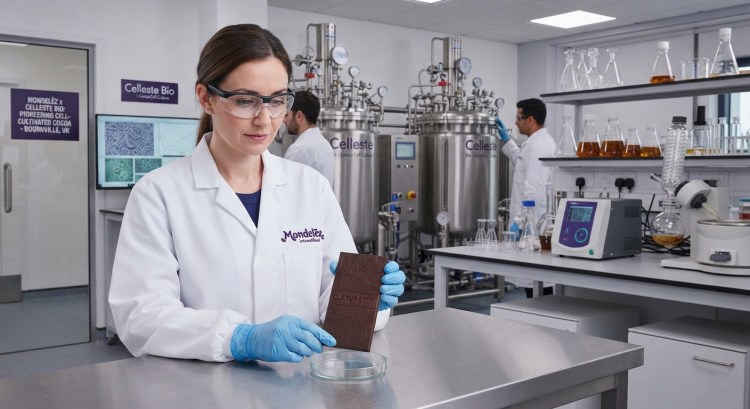
Cadbury’s parent company, Mondelēz International, has partnered with biotech startup Celleste Bio to produce prototype chocolate bars using cell-cultured cocoa grown in a laboratory.
Lab-grown foods are generally considered safe because they undergo rigorous regulatory approval and are produced in sterile environments, though experts continue to study potential risks like bioreactor contamination and long-term consumption impacts.
Lab-grown chocolate tastes and melts remarkably like the real thing because it is biologically identical, though early versions lack the complex flavour nuances that come from natural soil and farm fermentation.
While no multi-decade human data exists yet, the long-term effects of eating lab-grown chocolate include potential benefits like the total elimination of heavy metals and maximised heart-healthy antioxidants, though scientists are still studying how growth-liquid residues might affect human metabolism or the gut microbiome over time.
Lab-grown food is not automatically considered a GMO, as it is only labelled as such if the parent cells were intentionally gene-edited or genetically engineered during the production process.
Public opinion on lab-grown foods is sharply divided, with supporters praising its environmental benefits and ethical, slaughter-free production, while sceptics express deep concern over its high costs, the lack of long-term health data, and the rise of unnatural, ultra-processed food.
We actually need lab-grown foods to reliably feed a skyrocketing global population while eliminating the massive deforestation, carbon emissions, water shortages, and supply chain vulnerabilities caused by traditional agriculture.
Lab-grown food production requires highly advanced, pharmaceutical-grade infrastructure centred around massive steel bioreactors, sterile cleanrooms to prevent contamination, complex filtration networks, and a massive, continuous supply of clean water and electricity.
The heavy electricity and infrastructure demands of lab-grown food production significantly impact carbon emissions, meaning that if a facility relies on a fossil-fuel-dominated energy grid, its carbon footprint can actually end up higher than that of traditional agriculture.
Relying on fossil fuels to power lab-grown food facilities does defeat the core environmental purpose of the technology, which is why scientists stress that these products can only truly deliver on their green promises if the entire production infrastructure is powered by 100% renewable energy.
Critics and environmental researchers agree that advertising current lab-grown foods as an instant “green solution” borders on greenwashing, because companies often publicise the long-term, theoretical benefits of the technology while downplaying the massive fossil-fuel footprint required to run their actual, present-day factories.
When looking at the gap between corporate marketing and reality, the pattern of companies hyping up “eco-friendly” solutions while hiding a massive fossil-fuel footprint happens across almost every major industry today.
Public comments online reflect a deep-seated frustration with corporate “greenwashing,” with many people viewing lab-grown foods as a dystopian, overly processed con that masks a massive industrial carbon footprint under the guise of saving the planet.
The exact “Not In My Backyard” (NIMBY) sentiment is why lab-grown food companies face intense public resistance, as local residents rarely want massive, noisy, and potentially foul-smelling industrial bioreactor plants operating near their neighbourhoods.

