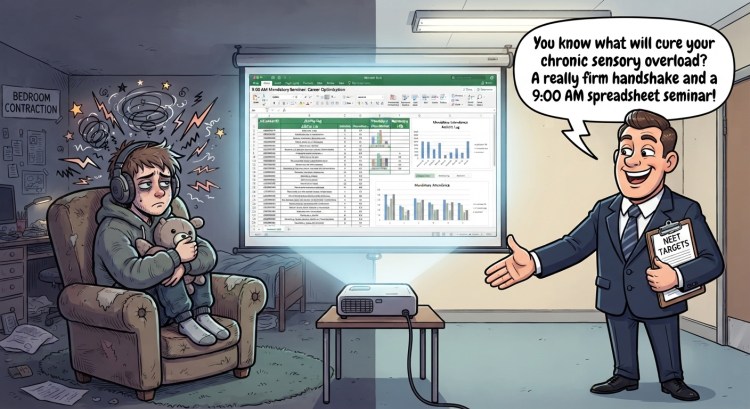
The great British welfare debate: where the government looks at a room full of burnt-out, neurodivergent 22-year-olds struggling to leave the house, strokes its chin, and says, “You know what will cure your chronic sensory overload? A really firm handshake and a 9:00 AM spreadsheet seminar.”
Depending on who you ask, stripping disability benefits from under-25s is either a catastrophic recipe for extreme poverty or the ultimate motivational life-hack.
Disability advocates and charities are collectively facepalming at the idea that financial panic is the missing ingredient for curing autism and chronic illness.
The government seems to believe that withholding cash acts like a magical spell that instantly cures ADHD, severe anxiety, and physical fatigue.
Cutting PIP or Universal Credit health elements doesn’t magically make gluten-free food, sensory aids, or specialised therapies cheaper; it just means people have to choose between heating and surviving.
Advocates point out that even if these young people wanted to work, most standard 9-to-5 offices have the sensory profile of a strobe-lit nightclub, which isn’t exactly a thriving environment for someone recovering from severe burnout.
Turns out, threatening people with homelessness doesn’t actually lower their cortisol levels or make them great candidates for customer service roles. Who knew?
On the other side of the aisle, policy reviewers are looking at a spreadsheet of nearly a million young people not in work or education and thinking, “We just need to rebrand adversity.”
Proponents want to replace standard cash benefits with a “youth allowance”—because nothing says financial security like a voucher that basically says, “Good luck at the career fair!”
The plan promises to swap financial support for an army of personal coaches and career advisors. It’s the ultimate “thoughts and prayers” approach, but with more CV-writing workshops.
Reformers argue that resources should only go to the “most severely disabled,” as if there’s a magical Sorting Hat that can perfectly judge exactly how many hours of Excel a person with chronic fatigue can handle before collapsing.
The Milburn Review reads less like a serious policy document and more like a tech-startup CEO trying to “disrupt” the concept of human suffering. If you ever wanted to see extreme clinical anxiety translated into the vocabulary of a LinkedIn influencer, this is your holy grail.
The review treats “The System” like a sentient, lurking entity. It officially defines it as the “interconnected architecture of education, skills, welfare, health, and employment services.”
The government’s core economic theory here seems to be that extreme financial panic is a broad-spectrum antibiotic capable of magically rewiring a human nervous system.
According to this master plan, disability isn’t a medical reality—it’s just a lack of hustle. By applying the corporate thumbscrews, the review introduces a truly historic logical leap.
Under the “Youth Allowance” logic, ageing is the ultimate medical cure.
If you are 24, heavily neurodivergent, and experiencing severe autistic burnout, you aren’t actually disabled. You’re just “experiencing bedroom contraction” and need a pep talk from a career advisor named Gary.
The exact microsecond the clock strikes midnight on your 25th birthday, a magical beam of light hits you. Your condition is instantly upgraded to a “legitimate adult illness” worthy of actual money. You didn’t recover; you just aged into your diagnosis like a fine cheese.
The system operates on the assumption that if you squeeze a traumatised person hard enough with the threat of starvation, they will simply choose to stop having a malfunctioning cortisol response.
The Strategy. Use the threat of absolute poverty to lower someone’s generalised anxiety.
Shockingly, threatening a young person with homelessness doesn’t cure their agoraphobia. It just creates a deeply traumatised, entirely broke person who is now too terrified to open their front door—let alone smash a group interview for a call centre.
The review writes about benefits as if young people are choosing chronic fatigue and sensory overload because the luxurious, jet-setting lifestyle of surviving on basic Universal Credit is just too addictive to quit.
The Logic. “If we make their lives completely unlivable, they’ll realise that being disabled is actually a massive hassle and opt out.”
Taking away the safety net doesn’t suddenly construct a “pathway to a career.” It just removes the floorboards so people fall directly into the basement.
Disability advocates, charities, and campaigners have looked at the government’s sleek new corporate playbook and collectively decided to set it on fire in the national press. Major players like Scope and Disability Rights UK are currently treating the Milburn Review like a terrible stand-up routine, roasting its logic on every media channel available.

