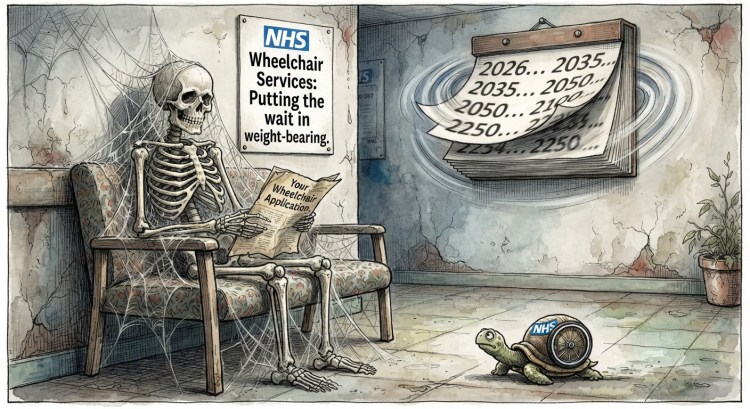
The Public Service Ombudsman’s new report, ‘Strengthening NHS wheelchair services: commissioning with confidence’, essentially confirms that getting a functional wheelchair through the NHS requires the patience of a saint, the luck of a lottery winner, and a timeline usually reserved for continental drift.
Launched at Westminster, the report highlights a system so spectacularly broken it borders on performance art.
The report highlights a child who waited 90 weeks for a wheelchair. By the time it arrived, they had presumably outgrown it, gone through puberty, and started looking at car insurance.
Annual complaints skyrocketed from 8 to 110 in five years. That is a 1,275% increase—crypto investors wish they had those kinds of numbers.
The NHS has no accurate count of how many wheelchair users actually exist in the UK. You can’t fail to meet demand if you pretend the demand is technically invisible.
Over 80% of complaints target private contractors who treat the official 18-week delivery target less like a legal standard and more like a gentle, aspirational vibe.
The MHRA regulates the physical chairs, but the Care Quality Commission (CQC) doesn’t regulate the actual service. If your chair is broken, the government effectively points at the sky and shrugs.
To fix this, the report suggests the Department of Health and Social Care try some radical new tactics.
Actually tracking how many humans need chairs.
Finding a senior official to look mildly uncomfortable when things go wrong.
Measuring success by whether a patient can leave their house, rather than how much money the local board saved by ignoring their emails.
Be prepared to run your wheelchair into the ground until it breaks, so it then becomes an emergency.
A custom wheelchair is the ultimate freedom machine, yet the NHS handles them with all the urgency of a teenager being asked to clean their room.
When you can’t walk, a wheelchair isn’t “furniture.” It is your legs. Forcing someone to wait two years for one is the equivalent of the government confiscating your lower limbs and telling you they’ll mail them back to you in “due course.”
A custom chair has to be perfectly fitted. The wrong cushion means agonising back pain or pressure sores. The contractor’s strategy? Give you a heavy, generic steel throne that manoeuvres like a shopping trolley with a broken wheel, and wish you the best of luck.
If a commuter’s car breaks down, it’s an annoyance. If a wheelchair breaks down, they’ll put you on a six-month waiting list for a single screw; you are literally trapped in your house like a Sim whose player deleted the front door.
The report notes that patients are often subtly nudged toward buying their own chairs privately. It’s a bold business model: make the public service so agonisingly slow that people willingly spend thousands of pounds just to escape the waiting room.

