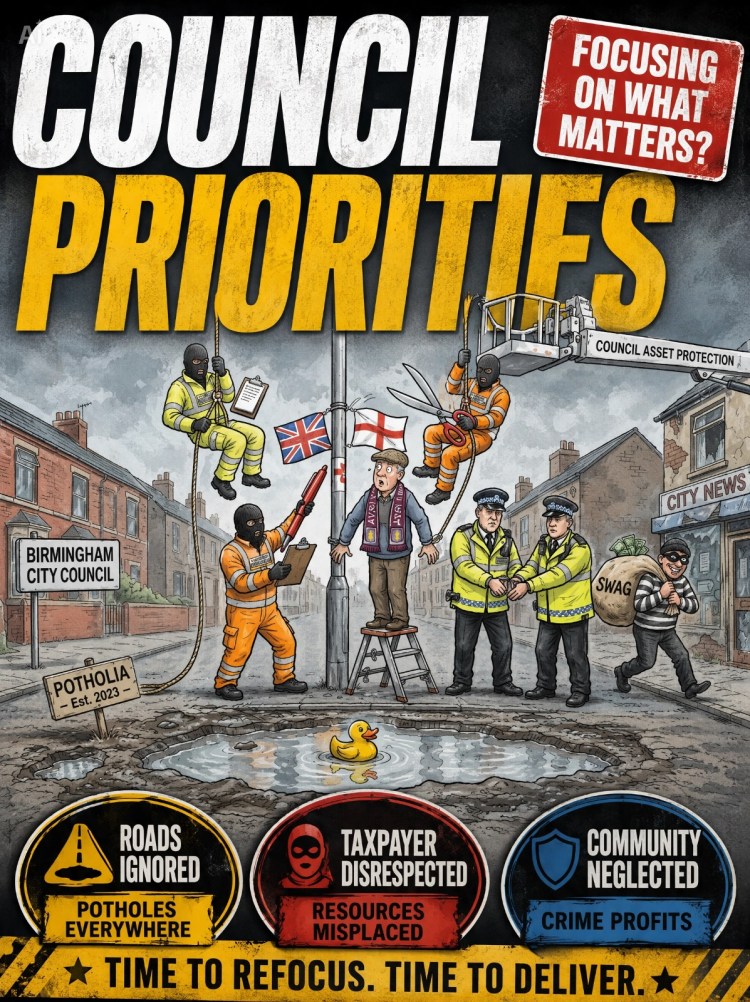
Birmingham City Council has boldly tackled the city’s most pressing infrastructure crisis: rogue bunting. Under a new High Court injunction, attaching an unauthorised Union Jack or St George’s Cross to a local lamp-post can technically land you in prison for up to two years—putting zealous DIY decorators in roughly the same legal bracket as mid-level bank robbers.
According to the council, this isn’t a war on patriotism; it’s a war on structural stress. They’ve already spent £170,000 taking the flags down—proving that no matter how bankrupt Birmingham is, there’s always emergency funding for a bloke with a ladder and a pair of scissors. Judge Emma Kelly reassured locals that they can still fly flags on their own homes. Good news, everyone: your national identity is completely legal, provided you have a mortgage.
British people are fiercely proud of their flags, though they treat them less like sacred relics and more like seasonal decor that only emerges during moments of extreme national stress—like a royal wedding, a jubilee, or England inevitably losing on penalties.
Unlike Americans, who will proudly hoist the Stars and Stripes above a suburban driveway on a random Tuesday in October, Brits generally treat year-round flag-flying with a mixture of quiet respect and mild suspicion. In the UK, putting up a flagpole in your front garden is widely seen as a bold declaration that you either run a bed-and-breakfast, are a retired naval officer, or have very strong opinions you’re dying to share at the pub.
For roughly three weeks every two years, the St George’s Cross becomes mandatory attire for every Vauxhall Corsa in the country, right up until the quarter-finals, when the flags are quietly stuffed back into the loft until 2028.
Nothing unites the nation quite like draping a Union Jack over a folding table in the drizzle to eat a slightly soggy sausage roll in honour of a monarch.
Ultimately, Brits love their flags deeply—they just prefer to express that love with maximum understatement, occasional bunting, and a strict adherence to local planning regulations.
If you’re confused about how flying the British flag in Britain could theoretically land you behind bars for two years, welcome to the wonderful world of UK local council bureaucracy—where common sense goes to retire and health-and-safety reigns supreme.
To be clear, Parliament hasn’t secretly banned patriotism. The “two years in prison” headline comes from a very British legal technicality. Birmingham City Council didn’t pass a law against the Union Jack; they took out a High Court civil injunction against attaching anything unauthorised to street furniture. In the UK, ignoring a High Court judge is “contempt of court,” which carries a standard maximum penalty of two years inside. That means in the eyes of the law, zip-tying a St George’s Cross to a streetlight puts you on the exact same legal footing as a rogue fly-tipper or a bloke illegally erecting a giant inflatable minion on a roundabout.
As for why the government isn’t stepping in, Downing Street doesn’t actually control what local councils do with their lamp-posts—and frankly, no Prime Minister wants to get dragged into a turf war with Birmingham’s highway maintenance department. Because the council argued it was about road safety, blocked signs, and rogue cherry pickers, the judge treated it like a giant council-wide “Keep Off The Grass” sign rather than a political statement.
So yes, Birmingham is very much still in Britain, and you are completely free to drape your house, your garden, your pub, or your pet whippet in as many Union Jacks as your heart desires. Just whatever you do, don’t touch the council’s lamp-posts—they’re apparently the only things in the city the council is willing to fight to the death to protect.

