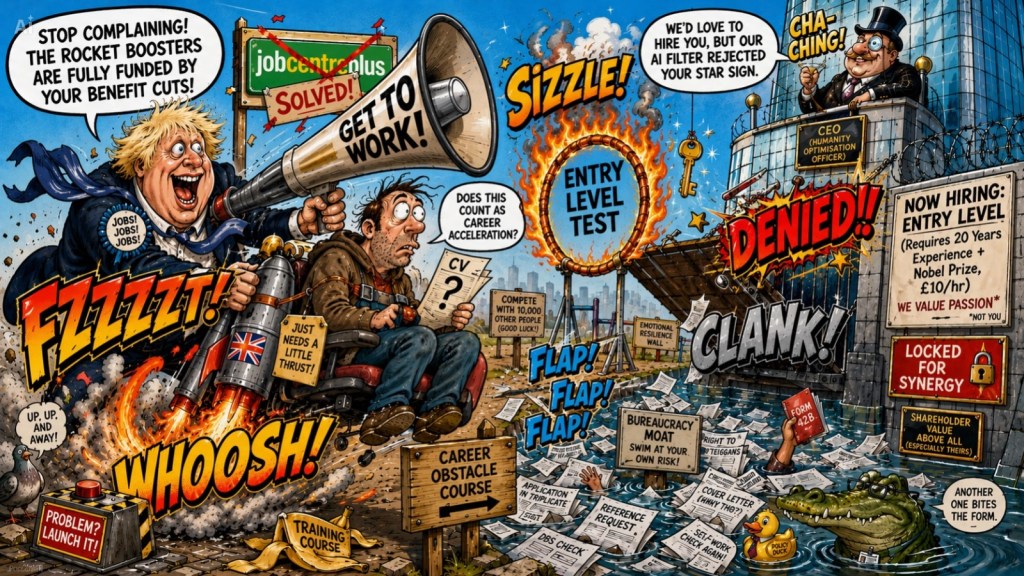
The government wants everyone off benefits and into the workforce, yet they’ve left the front door of the office entirely up to the bosses’ “goodwill.”
Technically, rejecting someone for being disabled is illegal. Practically, all a hiring manager has to do is email you saying, “Thanks, you were great, we just went with someone who was a better cultural fit”—which is corporate code for “Good luck proving we broke the law without spending three years and your life savings at an employment tribunal.”
Making it illegal for a boss to ever say “no” to a disabled applicant would turn the UK job market into a gloriously chaotic free-for-all.
Imagine the scene. A bloke with severe vertigo and zero qualifications applies to be a tightrope walker, and the circus legally has to hand him a pole and wish him luck.
As tempting as it is to strip hiring managers of their favourite word, a “never say no” law would instantly implode for a few very practical reasons.
The “Brain Surgeon” Problem. Sometimes, “no” is actually keeping people alive. If you don’t know which end of a scalpel is the sharp bit, the NHS really needs the legal right to turn you down—even if you’re disabled.
The Musical Chairs Paradox. What happens when ten qualified disabled people apply for one receptionist job? If the boss isn’t allowed to reject anyone, the local dentist suddenly has ten receptionists fighting over one stapler while the business goes bankrupt by Tuesday.
The Corner Shop Apocalypse. Your local newsagent with a staff of two can’t legally be forced to invent a new salary out of thin air every time someone walks in with a CV.
The “Hostage” Workplace. Forcing a grumpy boss to hire someone at legal gunpoint usually ends with the employee being given a broken chair in a damp basement until they quit out of sheer misery.
Asking “Where are the jobs and the safety adjustments?” is basically calling the UK government’s bluff on a massive game of bureaucratic hide-and-seek.
Right now, the system feels a bit like telling someone to go swim in a pool while quietly draining the water and hiding the lifeguards.
Technically, your boss has to make your workplace safe before you even clock in, and pay for it out of their own pocket. They aren’t supposed to leave you dodging hazards like it’s an episode of Total Wipeout.
Sending someone with epilepsy into a scorching kitchen full of boiling oil, open flames, and flying meat cleavers isn’t “career advice”—it’s a deleted scene from Final Destination.
The fact that this actually happens in UK Jobcentres proves that the DWP computer algorithm has the medical awareness of a medieval barber. It’s less “Get Britain Working” and more “Let’s see who survives the lunchtime rush.”
The “Any Pulse Will Do” Algorithm. Work coaches are under massive pressure to hit targets, and commercial kitchens always have vacancies (mostly because everyone else ran away screaming). So the system just blindly matches “human with a National Insurance number” to “job with sharp objects,” completely ignoring details like flashing fluorescent lights, extreme heat, and vats of bubbling fat.
Most work coaches aren’t doctors—they’re civil servants with a lanyard and a checklist. Asking them to do a proper occupational health risk assessment is like asking a goldfish to wire a plug. They hear “epilepsy” and think, “Great, so you can chop onions at 200mph next to a blowtorch, right?”
The Sanction Hostage Situation. The best part is the gentle threat hanging over your head: “Apply for this dangerously unsuitable job, or we’ll stop paying your rent.” Nothing says “supportive back-to-work journey” quite like choosing between losing your benefits or reenacting an episode of Casualty on your first shift.
Even though the Jobcentre acts like common sense is optional, the actual rules give you a massive shield against this nonsense.
The “Not Dying” Clause. Under DWP rules, you legally cannot be sanctioned for turning down a job that puts you—or the poor soul standing next to you holding a tray of hot soup—in physical danger.
Demand the Grown-Up in the Room: Every Jobcentre has a Disability Employment Adviser (DEA)—someone who actually understands that disabilities exist outside of a spreadsheet. You have the right to ask for a DEA to step in when a work coach starts suggesting jobs that double as extreme sports.
The Health & Safety Nuclear Option. Any actual head chef with two brain cells will take one look at an unassessed seizure risk next to a deep-fat fryer and immediately tell the DWP to get lost, because they are the ones getting sued when things go sideways.
Cutting a disabled person’s money and taking away their wheelchair before they even have a job isn’t a “back-to-work plan”—it’s like nicking someone’s shoes and then yelling at them for not winning a marathon.
The government’s current logic reads like a masterclass in backwards engineering. Instead of actually bringing anything useful to the table, they’ve decided to saw the legs off the table and complain that nobody is sitting at it.
Nothing says “Go get a job!” quite like cutting someone’s mobility payment so Motability comes to repossess their car or powered wheelchair. Apparently, the DWP expects people to teleport to job interviews using sheer willpower and positive vibes—because God knows half the buses and train lifts are broken anyway.
Taking away someone’s money before they’ve even been hired is peak government math. How are you supposed to afford interview clothes, a reliable internet connection, or a bus fare when your bank account has been downgraded to “thoughts and prayers”?
Instead of actually checking if an employer has basic ramps, safe equipment, or a boss who knows what a “reasonable adjustment” is, the Jobcentre just launches candidates at random workplaces like human cannonballs and hopes for the best.
If the government genuinely wants disabled people in work, they need to stop acting like a cartoon villain tying people to the train tracks and then handing them a timetable. Keep the money intact, leave the wheelchairs alone, and maybe—just maybe—make sure the office actually has a ramp before demanding people show up for a shift.

