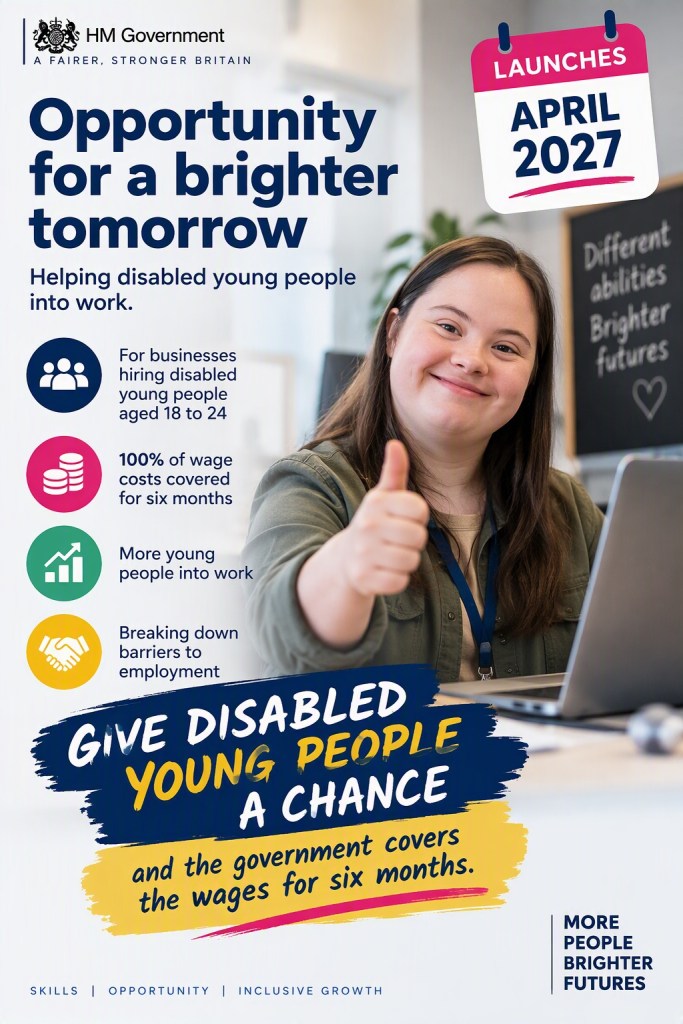
Under a major new government scheme launching in April 2027, businesses hiring young disabled workers aged 18 to 24 will have 100% of their wage costs covered for six months.
If the government extended the wage subsidy to one or two years, it would give businesses a much stronger, long-term incentive to truly invest in training and retain young disabled workers.
The Department for Work and Pensions is rolling out an initiative to offer fast-tracked, state-funded jobs to thousands of young adults living with disabilities and long-term health conditions.
The DWP scheme works by fast-tracking a voluntary, fully funded six-month job offer to young disabled adults just three months after their Work Capability Assessment, with the government covering 100% of minimum wage costs for up to 25 hours a week.
Backed by a £2.5 billion Jobs Guarantee, the scheme will offer completely voluntary, guaranteed paid roles to young adults aged 18 to 24 who are currently receiving health benefits.
Companies will accommodate these workers by fulfilling their legal duties under the Equality Act, utilising government-funded Access to Work grants for specialist equipment or premises alterations, and utilising integrated wraparound mentors to support workplace transitions.
The entire scheme is funded by the UK taxpayer through the Department for Work and Pensions, costing an estimated £750 million as part of a wider £2.5 billion package aimed at ultimately lowering the long-term welfare bill.
Every penny of the £750 million scheme is entirely bankrolled by British taxpayers rather than an independent government fund, as the state ultimately has no money of its own.
The UK state has no money of its own because governments do not generate independent wealth, meaning every pound they spend must first be raised from the productive private economy through taxation or by borrowing against future tax revenues.
While the UK is globally classified as a wealthy nation based on its massive £4.2 trillion annual gross domestic product, the state itself is not independently wealthy since every pound it spends must be forcibly extracted from citizens or borrowed against their future earnings.
A government is necessary because, unlike accountants who simply balance spreadsheets, a state holds the unique legal authority to enforce laws, maintain national security, and make moral, political choices about how a nation’s resources should be redistributed.
While the state holds a theoretical legal authority on paper, that authority fails in reality when the government cannot fulfil its primary duty of protecting citizens from street gangs who kill and maim with apparent impunity.
The legitimate fear that prejudiced employers will exploit short-term subsidies as free, disposable labour and dismiss vulnerable workers the moment funding dries up highlights why state support must be directed toward the individuals themselves rather than corporate interests.
Because training new staff requires a significant investment of time and resources, it is financially logical for employers to retain these young adults after the six-month subsidy ends rather than continually repeating the costly training cycle with new hires.
Because the hidden operational costs of onboarding—including lost productivity from senior staff and the standard learning curve—represent a massive investment, it makes zero financial sense for a business to train a worker for six months only to let them go and repeat the costly cycle.
When the six-month subsidy ends, the taxpayer funding stops completely, and the worker either transitions into a permanent role with the company, moves onto a state-supported apprenticeship, or enters the wider job market equipped with recent, certified work experience.
While six months of verified work experience gives these young adults a competitive edge that many peers lack, boosting individual employability cannot generate new vacancies unless paired with structural labour shifts like lowering the state pension age to encourage retirement.

