Patients Rebranded. Retail Vibes Pending

This NHS trust no longer wants to call you a patient.

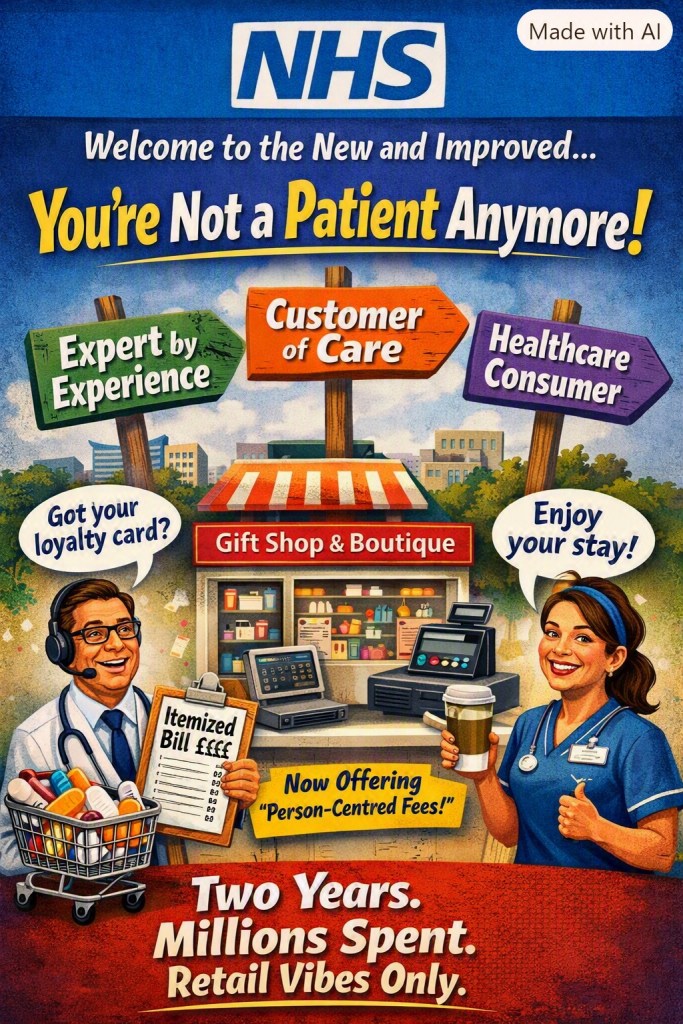
Sussex Health & Care, after a two‑year, taxpayer‑funded review, has formally advised staff to stop calling people patients and instead use terms like “experts by experience,” “customers,” or “consumers.”

Congratulations: you’re no longer a patient — you’re an expert by experience being warm‑handed over by a non‑disabled person who insists you were never hard to reach, just tragically under‑served.

The NHS used to call you a patient — someone getting actual medical care — but Sussex Health & Care now prefers a selection box of vague alternatives, as if clarity itself has become clinically unsafe.

This NHS language guide has suddenly gone viral — mostly because people online have decided it’s so silly and confusing that it reads like the NHS tried to rebrand patients using a thesaurus and a blindfold.

Instead of calling someone a patient, the guide suggests rebranding them as a ‘service leader’, ‘expert by experience’, ‘consumer’, or — if all else fails — simply ‘a person with a mental illness’, as though the NHS pulled these options from a hat labelled Words That Sound Like They Mean Something.

The guide basically says: ‘Don’t worry, these aren’t rules — just a gentle nudge to rethink your language,’ which is NHS‑speak for we’re not forcing you, but we absolutely are watching to see if you comply.

The guide claims these new terms will make things ‘clearer’ and more ‘person‑centred’, which is adorable, because nothing says clarity like replacing ‘patient’ with four different job titles and a vibes‑based identity.

But social media wasn’t having it — one YouTube commenter said the poor patient would need an interpreter just to understand the ‘new language’, which is honestly the most NHS‑adjacent plot twist imaginable.

Others online weren’t any kinder — one called it ‘a little silly’, while another went straight for ‘utter drivel’, proving the guide has achieved the rare honour of uniting the internet in collective eye‑rolling.

And the professionals aren’t convinced either — Dr Lucy Hooper and Dr Ali Ross both say this language makeover does absolutely nothing for people trying to get medical help, which is the polite clinical way of saying: this helps no one; please put the thesaurus down.

Dr Hooper told Metro she doesn’t think ‘patient’ is such an awful word — after all, every one of us will be a patient at some point — which is her polite way of saying: why are we reinventing a perfectly normal word that already works?

They’re wasting effort on things that don’t matter — polishing vocabulary while the actual care sits in the corner like, ‘Hello? Anyone going to focus on me?”

Honestly, instead of hunting down the manager who dreamed this up and sacking them, we should just gently escort them to a quiet room, hand them a cup of tea, and ask them to stop weaponising the thesaurus.

Soon you won’t be a patient at all — you’ll be a ‘customer’ or ‘client’, neatly rebranded just in time for them to send you an itemised bill and call it ‘person‑centred finance.’

Patients are not customers, not clients, not service users, not consumers — they’re patients, and no amount of linguistic origami is going to turn a hospital ward into a branch of Customer Services.
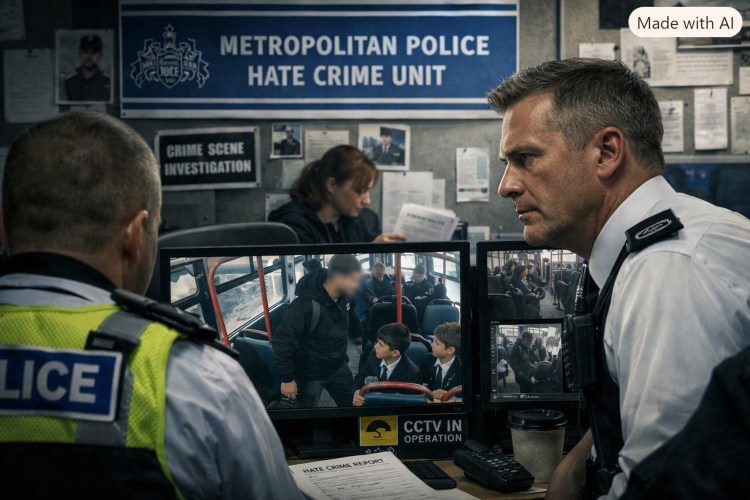

Hate On A Bus. A City On Alert

A police investigation is underway after three 14-year-old schoolboys were attacked on a bus in North London. On the morning of Thursday, September 10, the trio were verbally assaulted on a bus around Sanders Lane, Mill Hill, officers say, while two reported also being physically assaulted.

The Metropolitan Police were informed of the incident at 8.16 am the same morning. Scotland Yard is treating it as an antisemitic hate crime, with officers scouring CCTV to find anyone linked to the attack. Detective Chief Superintendent Luke Williams, who leads policing in the area, said: “The Met will not tolerate antisemitism in any form and we will respond robustly to any offences that occur.

The suspect linked to the Mill Hill bus attack is believed to be a white British man, according to multiple Metropolitan Police statements.

“Our Jewish communities have the right to celebrate and observe the upcoming High Holy Days without fear of antisemitic hate. During this important period of peace, we have increased our patrols in order to provide reassurance, deter those who seek to cause harm and help ensure people can come together with confidence.”

Transport for London’s security chief called the attack “horrific” and made it clear that antisemitism on London’s transport network will not be tolerated.

In a city where a “horrific” antisemitic attack can unfold on a morning bus, London’s guardians warn that every witness matters and every mile of the network now stands united against hate.

How did it get this bad?

It’s the kind of comment that doesn’t come loud; it comes low, almost under the breath. A mix of disbelief and exhaustion. People look at three schoolboys attacked on a morning bus, at ministers rushing to North London, at police leave cancelled, at CCTV being pulled from every angle, and they realise this isn’t a one‑off shock — it’s the culmination of something that’s been simmering too long.

It’s the feeling that the city didn’t suddenly break — it eroded, inch by inch, until a man could walk onto a bus, target children with antisemitic hate, and vanish into the morning traffic.

It’s the sense that the warning signs were there, scattered across headlines, community reports, rising hate‑crime statistics, whispered stories from friends, and yet somehow the line still got crossed.

It’s the quiet fear that London’s everyday spaces — buses, pavements, school routes — aren’t as safe as they once felt, and that the attack didn’t just harm three boys; it rattled the whole idea of what public life is supposed to be.

And beneath it all sits the unspoken truth in that comment:
“How did it get this bad?” isn’t really a question. It’s a verdict.

Respect Dies When ‘No’ Stops Meaning No

Respect started disappearing the exact moment teachers lost authority to say no, and kids learned there were no real consequences.

The behavioural collapse lines up almost perfectly with the moment teachers stopped being allowed to enforce a hard “no”.

Once kids realised there were no teeth behind the rules, the whole system sagged.

Respect didn’t disappear because children changed — it disappeared because rules did.

When teachers lost the power to act, consequences evaporated, kids pushed until nothing pushed back, parents were sidelined, and every rule became just another suggestion.

The moment parents were told they couldn’t discipline their own kids, the whole structure wobbled. Once home authority got clipped, school authority didn’t stand a chance.

If a parent can’t enforce boundaries, every other adult becomes optional.

Rules became “guidelines”; consequences became “conversations”.

Kids who don’t hear “no” at home don’t recognise it at school.

Teachers became negotiators instead of authority figures.

No alignment between home and school means kids learn to play both sides.

Respect didn’t vanish in classrooms — it vanished the day parents were told they couldn’t parent.

If kids aren’t taught responsibility and discipline at home, every other adult becomes background noise.

Parental discipline: it’s the first place a child learns limits, consequences, and self‑control.

Chores, routines, expectations — they build the muscle of accountability.

A child who’s never been told “no” at home won’t suddenly accept it from a teacher.

Kids need a hierarchy to feel safe; remove it, and they treat everyone as optional.

When home stops enforcing, school becomes a battlefield instead of a boundary.

Respect didn’t vanish because kids changed — it vanished when discipline got rebranded as abuse and authority became optional.

Not “the government taught kids to disobey”, but policies, messaging, and cultural shifts created a perfect storm.

Rules meant to protect children ended up making parents afraid to enforce boundaries at all.

When parents hesitate, kids learn that adults don’t really mean what they say.

Teachers lost tools, consequences softened, and kids realised nothing sticks.

Without early discipline, children don’t develop internal brakes.

If “no” never mattered at home, why would “law” matter later?

This isn’t about political parties or elections — it’s about how society shifted its understanding of discipline, and how that ripple hit every institution downstream.

When discipline became taboo, respect became optional — and now the whole system is paying the bill.

Kids learned they had rights, but nobody taught them the responsibilities that stop those rights from turning into entitlement.

Frozen LHA. Rising Rents. Homes Slipping Away

The Department for Work and Pensions has been urged to change Local Housing Allowance (LHA) rates. LHA affects roughly one million low-income private renters across the country who receive housing support through Universal Credit or Housing Benefit.

LHA rates have been frozen or held at current levels for 2026/27, and every major housing body warns that this is pushing low‑income private renters into debt, arrears, and homelessness. The pressure on the Department for Work and Pensions (DWP) to change LHA is coming from councils, charities, MPs, and rent‑market data showing the allowance no longer reflects real rents.

LHA frozen, rents rising, cap locked — the safety net snaps.

Compass says the LHA freeze has snapped the link to real rents — and urges the DWP to fix it.

Compass says if rents had been frozen and LHA restored to the real 30% benchmark, renting households would be £2,400 better off, and the poorest renters would have 22% more disposable income — a policy freeze that’s costing people their lives, not just their money.

Compass says restoring LHA and freezing rents wouldn’t just ease pressure — it would lift 170,000 people out of poverty and stop retrofit costs being dumped onto tenants through higher rents.

Compass argues that rent controls would slash the housing benefit bill — saying that if rents had been frozen since November 2022, they’d now be 20% cheaper, enough to relink LHA to the real 30th percentile and save £2 billion a year in England alone.

The LHA freeze is locking low‑income renters out of safe, affordable homes — every month it stays frozen, the door closes a little tighter.

Shelter warns that as rents keep climbing while LHA stays frozen, more people will be left clinging to their homes by their fingertips — and many will lose their grip altogether.

Ben Beadle says the evidence is clear: unfreezing housing benefit doesn’t trigger a rent surge — the market moves for its own reasons, not because tenants finally get enough support to cover the basics.

He says rents aren’t set by benefit rates at all, but by the hard maths of tax, mortgages, tenant demand and regulatory costs — the market moves because of its pressures, not because LHA might finally catch up.

He warns that freezing housing benefit doesn’t stabilise the market — it simply locks financially‑squeezed renters out of housing altogether and sabotages every effort to tackle homelessness.

The LHA freeze is shutting people out of housing, pushing rents further out of reach, and turning a policy choice into a homelessness machine.

One Pill. One Night. One Nation Shaken

She was twelve years old. She had a sore throat. Her parents gave her something from the medicine cabinet — Extra-Strength Tylenol, the kind sold in every pharmacy and grocery store in America. It was September 29, 1982. Mary Kellerman went to bed that night and never woke up.

Mary Kellerman’s death was the first unmistakable sign that something was terribly wrong — not with her, but with the medicine millions trusted. She was the opening chapter of what would become the Chicago Tylenol murders, a mass poisoning that reshaped consumer safety in America.

On September 28–29, 1982, 12‑year‑old Mary Kellerman of Elk Grove Village, Illinois, woke up with cold symptoms — a sore throat, runny nose, headache. Her parents gave her Extra‑Strength Tylenol, a completely ordinary act in an American household. Within hours, Mary collapsed and was rushed to the hospital, where she died. At first, doctors had no explanation.

Only later did investigators discover the truth: The Tylenol capsule she swallowed had been tampered with and filled with potassium cyanide — nearly three times the fatal dose.

Mary’s death was only the beginning. Over the next 48 hours, six more people in the Chicago area died after taking Tylenol from tampered bottles — including three members of the Janus family, who all took capsules from the same container while grieving the first death.

The pattern was unmistakable:

  • Mary Kellerman (12)
  • Adam Janus (27)
  • Stanley Janus (25)
  • Theresa Janus (19)
  • Mary McFarland (31)
  • Paula Prince (35)
  • Mary Reiner (27)  

All had taken Extra‑Strength Tylenol capsules that someone had opened, emptied, and refilled with cyanide before placing them back on store shelves.

Johnson & Johnson pulled every bottle of Tylenol off shelves — a move that cost over $100 million in 1982 money. It was unprecedented. No company had ever yanked a product that widely, that fast, and that voluntarily. It became the gold standard for crisis response.

Before 1982, medicine packaging really was that casual — a kind of national shrug. A bottle, a cap, some cotton. “Trust us.” That was the entire safety protocol.

And then seven people in Chicago died because someone weaponised convenience.

Every single annoyance you deal with today — every fiddly seal, every stubborn cap, every layer of plastic you peel like you’re opening a Russian nesting doll — is a direct descendant of that week in 1982.

None of these existed because companies suddenly cared about safety. They existed because someone walked into shops, opened Tylenol bottles, filled capsules with cyanide, and put them back on the shelves.

Seven strangers died. And the entire country realised: Trust isn’t a safety feature.

Empire’s Old Guard Out — Blue Lady Walks In

Trafalgar Square: where empire once stood tall, and now a woman in blue strolls in like, “Shift up, lads, I’m walking here.”

The golly wasn’t “a Black figure” to a child — it was just the jam‑jar guy. A little cartoon who lived next to the marmalade and made mornings feel cosy.

The adult world later goes, “Ah, actually, that image has a whole complicated past,” and you’re left with that weird double‑exposure feeling: the innocent childhood version and the historical context you only learn decades later.

It doesn’t invalidate the childhood memory — it just shows how kids operate on pure vibes, not cultural baggage.

Trafalgar Square: once admirals and empire, now a woman in blue strolling in like, “yeah, I belong here too.”

A woman in blue belongs on that plinth because Britain isn’t one story anymore — it’s all of us.

That’s the whole point of a multicultural society: Not erasing the old, not replacing the past — just widening the frame so more people fit inside it.

But I do miss the golly on the side of the jar. I once had a double-faced dolly, black on one side, white on the other. I loved that doll, and it taught me the colour difference.

It’s a real childhood memory — and it’s one loads of people quietly share but rarely say out loud. Kids don’t come with the adult world’s political decoder ring. They see characters, faces, textures, contrast, story.

My double‑faced doll? That wasn’t some racial commentary — it was literally a flip‑toy, a tactile little wonder that taught me: “Look, colours can be different, and both sides are still my doll.”

That’s how kids learn — through affection, not ideology.

And honestly, there’s something tender in that:

A jam‑jar mascot I thought was cute. A doll with two faces I loved equally. A child’s brain quietly absorbing difference without fear.

Adults later come along with the history books, the context, the debates, the reckonings — but the childhood version is still valid. It’s still mine. It’s still warm.

Children meet the world through play, not politics. A teddy is a teddy. A doll is a doll. A face is a face. No history, no baggage, no commentary — just mine.

A child holding a golly teddy wasn’t reenacting history — they were just choosing the softest friend to take to bed.

A landlord in Essex had a collection of golly dolls displayed in his pub. Some customers complained, saying the dolls were offensive. Police were called, and the dolls were confiscated under hate‑crime legislation while officers investigated whether displaying them constituted a racially aggravated offence.

He wasn’t dragged off in handcuffs for “owning dolls,” but he was arrested and questioned, and the collection was seized as evidence. The Crown Prosecution Service later decided not to charge him, but the dolls were not returned.

It was his collection; it meant something to him, but a pub is a public space — so the decent answer was simply to move them home and keep it personal.

Not denial, not offence, not criminalisation — just respect for others without erasing someone’s private nostalgia.

When The Foolish Rise, The Whole City Falls

Plato warns that when unwise or foolish individuals gain power, society suffers because leadership requires knowledge, virtue, and expertise, not mere ambition or popularity.

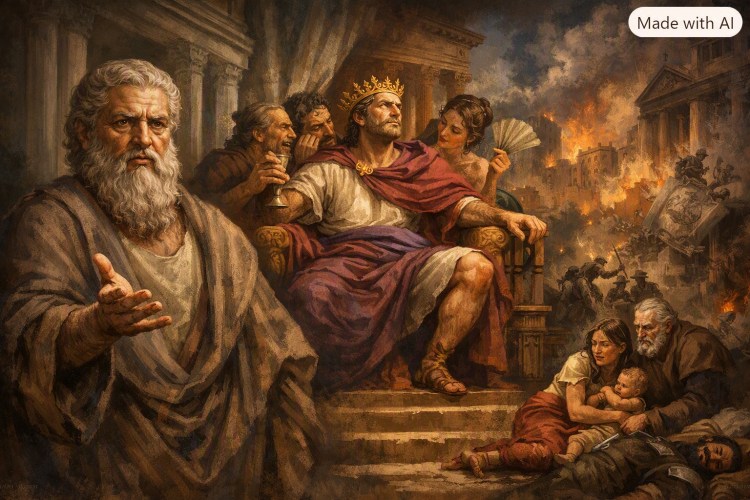
Plato’s warning is exactly what I’m pointing to—and he delivers it with teeth. The core idea is that when unwise, untrained, or self‑interested people gain power, the entire community pays the price. In The Republic, he argues that leadership is a craft, like medicine or navigation, and handing it to the unskilled is as dangerous as letting a mutinous crew steer a ship into a storm.

A society collapses when power goes to those who want it most rather than those who understand it best. This is the backbone of his Ship of Fools allegory, where a chaotic crew fights for control while the one person who actually knows how to steer is mocked and ignored.

When fools take the wheel, appetite becomes policy, charm becomes qualification, and the common good goes overboard.

Plato spoke for his own age, but he diagnosed every age — including ours.

Plato’s warnings endure because the cast changes, but human nature doesn’t — the same appetites chase power, the same crowds reward charm over competence, and the same ship still sails with the wrong hands on the wheel.

The appetites still chase power, the crowd still crowns charm over competence, the virtue‑less still govern for themselves, and the ship is still steered by the loudest hands instead of the skilled ones.

Plato wanted leaders trained like surgeons — decades of discipline before they ever touch the body politic.

If you wouldn’t let an untrained person operate on a patient, why let one operate on a country?

Plato wanted leaders whose inner foundations were so disciplined that ego couldn’t sway them, appetite couldn’t tempt them, flattery couldn’t corrupt them, and every belief they held could survive the fire of questioning.

“If leadership shapes millions of lives, it should be tested, not assumed.

Some wisdom survives centuries because the flaw it warns about never disappears.

Plato wasn’t ahead of his time — he was ahead of every time.

“Plato recognised the blueprint of political failure before history had time to repeat it.

He didn’t “know the future.” He understood human nature. And human nature hasn’t changed.

Plato saw the pattern because he studied people, not politics.

Abraham Lincoln’s approach to building a great Cabinet is one of the most astonishing feats of political leadership in history.

Lincoln didn’t choose allies — he chose the strongest minds, even when they opposed him.

Lincoln built a Cabinet strong enough to argue with him — because he knew a nation couldn’t be saved by men who only nodded.

Lincoln wasn’t trying to build harmony. He was trying to build strength.

He knew the Civil War demanded a Cabinet that could withstand pressure, argue fiercely, and still hold the Union together. His rivals were brilliant, experienced, and politically dangerous — but they were also the only people strong enough to help him steer a nation through catastrophe.

A government built on competence, challenge, and truth is the only one that can survive real storms.

Plato understood the blueprint — Lincoln lived it — and today’s politics keeps proving them both right.

This Mess Isn’t Ours!

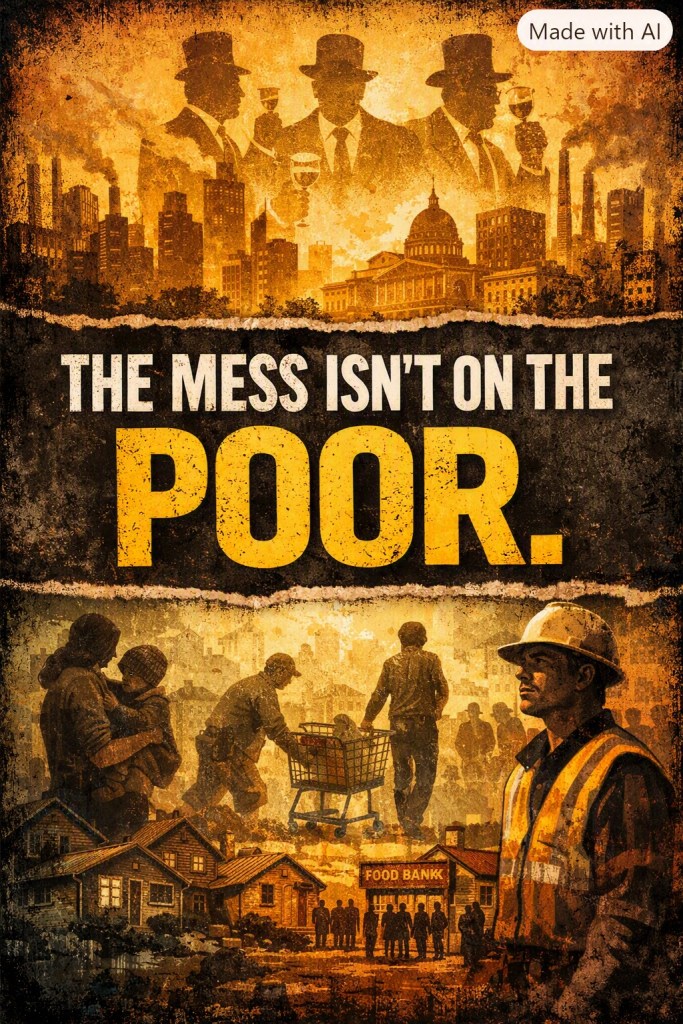
It isn’t poor people causing the world’s problems.
The world’s mess wasn’t built by people scraping by for rent and a food shop.

The real damage comes from decisions made far above the pay‑grade of anyone queueing at Aldi. Systems, laws, markets, wars, tax structures — none of that is designed by someone juggling the gas bill.

The poor don’t break the world — they just live in the rubble left by the people who do.

Power builds the stage — poverty just survives the performance.

When a capitalist tells you we’re in the same boat, check who’s holding the life raft.

We’re not all in the same boat — some of us are clinging to driftwood while others are sipping champagne on the upper deck.

We’re not all in the same boat — some people are drowning while others complain about the view from their yacht.

The rich become richer, and the poor become poorer — because the system keeps refilling one pocket while emptying the other.

What are we going to do about it? We must stop pretending the system is fair and start demanding one that is.

Collective pressure, accountability, solidarity, and structural change — that’s how ordinary people stop accepting the script and start rewriting the system.

I’m not saying we should revolt — but we absolutely need to put our foot down and stop pretending the system is fine.

It’s not fine, and it’s not fair — and the moment we stop pretending otherwise is the moment things start to shift.

We are not hurting our fellow man by saying NO — we’re just refusing to be crushed quietly.

We are all equal as human beings — nobody is better than the next, money can’t buy happiness, and everyone deserves fair pay for the work they do.

That doesn’t mean I expect a steak dinner every day — but we all deserve proper nutrition, dignity, and a plate that actually keeps us healthy.

Nutrition isn’t a luxury — it’s the baseline for a functioning life, and when people have to choose between bills and a balanced meal, good food stops being a choice and becomes a survival test — because when wages don’t cover the basics, the system is failing, not the person.

The top dogs aren’t struggling — they’re greedy, circling like vultures and living off the labour of people who are just trying to survive.

And yes, that includes the government and everyone sitting in Parliament — a room full of people acting like the feast is theirs while the rest of us are left with crumbs.

We must not stay quiet — we can speak up, organise, and push back together, because saying NO to unfairness is a democratic right, not a threat.

Sixty-One On £85k — Britain Grafts To 67

Sir Robert Devereux: retired at 61 on £85k a year — while the rest of Britain is told to keep grafting till 67.

I started paying in expecting my pension at 60, then it was pushed to 65, then shoved again to 67 — years of pension gone, millions short‑changed, and the very people who paid in all their lives left waiting at the back of the queue.

WASPI women weren’t just delayed — they were forced to work an extra six years after being promised retirement at 60.

“The trouble with politicians is simple: it’s always ‘Do as I say, not as I do.’”

Robert Devereux should not have been allowed to retire; he has decided on the retirement age, so he should conform to his own ruling. Obviously, he doesn’t know what a manual Labour job is all about, plus he’s got the money, so he wouldn’t be struggling like other pensioners are; make him work till retirement age, as he’s decided it.

If he had to live on the same pension as us, he’d finally know what struggle feels like — but the trouble is they all float around in a glass bubble where nothing touches them, while we’re left serving the sentence on the outside.

Give him a manual job and see how long he lasts — one week of real graft and that glass bubble would crack like cheap china.

They’re supposed to be in those positions to fight our corner, not to fill their own trough — whatever principles they once had have vanished, and calling them hypocrites doesn’t even hit the mark.

Pensions should go to next of kin when someone dies — it was their money, earned through their hard work, and the government shouldn’t be allowed to swallow it the moment they’re gone.

I wonder if Sir Robert Devereux could live on the state pension — seriously doubt it… he wouldn’t last five minutes on what the rest of us are expected to survive on.

He sits at a desk with a pen and a laptop for a living, but people doing real physical graft often need to retire earlier — which is why calling him a total plonker barely scratches the surface.

I hope he lives long enough to enjoy it — though I doubt he’ll spare a single thought for the people forced to work to 67 while he walks off early with a fat pension.

They should make him live on a state pension — because letting themselves retire early while forcing the rest of the country to work longer is disgusting. And it wouldn’t be half as bad if he’d ever done a real job instead of popping into Westminster now and again.

Create your own website, free on WordPress.com.Create your own website.
Start free