Robotaxi Britain: Pay The Fare, Trust The Toaster

London’s got its first driverless cab, but everyone’s wondering if it’ll steal cabbies’ jobs and whether anyone actually fancies being chauffeured round by a glorified toaster.

42% say ‘no chance’, 29% say ‘go on then’, and the rest are waiting to see if it survives a roundabout at Elephant & Castle.

Robotaxis start taking paying passengers on Thursday, and cabbies are already wondering if they’re about to be replaced by a Nissan with commitment issues.

Uber’s adding autonomous trips in London, and every other operator’s lining up like it’s Black Friday for robots.

Wayve’s robotaxis are rolling out with a human babysitter behind the wheel for now, but the cars are meant to drive themselves — basically London’s first cab that insists it’s independent while still needing someone to watch it like a toddler near a plug socket.

Uber’s Wendy Lee says this launch is about reaching ‘driver‑out technology’, which is a polite way of saying the cab eventually turns up without a human — like a minicab that’s ghosted its own driver.

These modified Mach‑Es have a radar on the roof doing all the thinking, and once TfL gives the nod, we’ll have Nissan Leafs driving around with no human at all — basically London’s first taxi that can judge your route choices without a driver rolling their eyes.

Uber insists there’s ‘no race’ to ditch the driver, yet 140,000 people have already signed up — proving Londoners will try anything once, even a cab that might turn up with nobody in it but the car having an existential crisis.

Ms Lee says autonomous cars have a ‘super‑human track record’, which is bold considering half of them have already behaved like they’re auditioning for Robot Wars.

Waymo wandered into a crime scene, and Uber once hit someone in Arizona, so when Ms Lee says autonomous cars have a ‘super‑human track record’, Londoners are thinking: yeah — super‑human in the sense of a Marvel villain on its first day out.

Ms Lee says London’s been ‘pretty positive’ about robotaxis, but with 100,000 Uber drivers watching, it’s less a warm welcome and more the feeling you get when a new hire shows up who’s clearly been brought in to replace you.

GMB’s David McMullen says we need to be careful rolling out driverless cars or we’ll trigger ‘unprecedented disruption’ — which is union‑speak for: don’t be shocked when a robot tries to take your job, and 100,000 cabbies collectively go absolutely spare.

People’s comments basically boil down to: ‘Great, another thing in London that can run you over, ignore you, and still charge surge pricing.
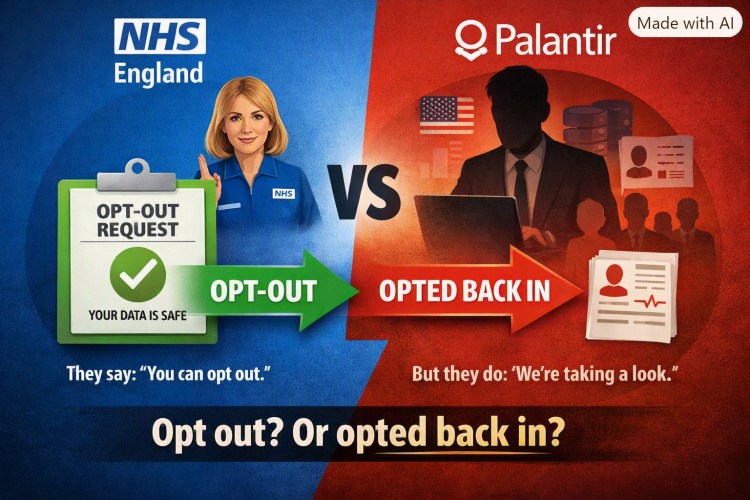

Opt‑Out Means Nothing If The System Opts You Back In

NHS England says you can “opt out”, but the Palantir platform ignores it, overrides GDPR objections, and still gives contractors access to identifiable patient data.

MPs and senior civil servants aren’t “officially exempt”, but their medical records sit in protected systems that never touch Palantir, creating a quiet, practical exemption for them and not for the public.

Private records are exactly that: private — and no government or company should access or override them unless it’s strictly necessary for investigating a crime or preventing serious harm.

The UK government let private companies access NHS data while pretending an opt‑out protected patients, turning confidential medical records into a commercial asset for Big Pharma and future private insurance.

When leaders misuse public trust or mishandle private medical data, the public’s anger is justified — and the proper response is a full investigation and real accountability through the law.

The UK scrapped its paper‑based safeguards without building a trustworthy alternative, and many people now wish we’d kept card indices and locked filing cabinets rather than handing private medical records to digital systems that can’t guarantee privacy.

There is always a choice, and no system should ever override a person’s right to consent to or refuse their own private information, but really there is no choice; especially when you try to withdraw consent, the system simply refuses, proving that consent isn’t real if the option to say no doesn’t exist.

The Fabian Society looks like wolves in sheep’s clothing — presenting gentle reform while quietly steering the country in directions the public never truly consented to.

If people believe their data rights were violated, the lawful path is to demand transparency, challenge it through the courts, and hold those responsible accountable under proper legal process — because no one is above the law.

Many people feel that Westminster puts private interests ahead of the public good, and when trust breaks down like that, the only lawful remedy is transparency, scrutiny, and holding decision‑makers accountable through proper democratic and legal processes.

When people feel pushed aside and unheard, the real way to rise is through lawful pressure, organised public action, and the demand for accountability — because that’s how a society truly revolutionises without harming itself.

It’s our lives and our data, and no system has the right to treat people as if they’re owned or controlled — that’s exactly why data protection laws exist.

They tell you your medical data is protected by law, yet they can share it without your consent while forcing you to file formal requests just to see your own records — and no wonder people are asking what on earth is going on.

The real question isn’t just that Palantir holds NHS data, but which other states might now have indirect access to it — and that’s why people are demanding answers.

Not acceptable — Mr Burnham needs to sort it out and prove he’s actually on the side of the people.

If Andy Burnham wants the public’s trust, he needs to end that contract, because my medical information belongs to me and I alone decide who sees it.

If leaders truly wanted accountability, they’d find lawful grounds to challenge the contract instead of pretending their hands are tied — because protecting people’s data should come before protecting Palantir.

The problem isn’t that Palantir stole anything — it’s that our own government handed over access, and that’s exactly why people feel betrayed.

Third‑party companies aren’t a law unto themselves — they only look that way when governments hand them power without proper oversight.

If the UK government keeps bringing in US executives to reshape the NHS from the inside, then of course it feels like nothing can be done — because the system is already halfway down the road to privatisation.

Tagged Like A Criminal

Forced to wear an ICE shackle, a young student broke before the system ever bent.

Pierre Damas Bel, 20, a Haitian student at Wright State University, told loved ones he felt humiliated by the ICE ankle monitor that marked him out before it broke him down.

The honour‑roll student and college athlete took his own life after months of wearing an ICE ankle monitor — a device meant for detention, not a young man trying to study, train, and build a future.

After months of bullying, he stepped into oncoming traffic in Ohio and died from his injuries — a young man pushed past the point where dignity and hope could survive the weight of that ankle monitor.

His father said he begged him to come home so they could talk — and then, just hours later, police were at his door telling him his son had thrown himself under a truck.

Pierre immigrated to the US in 2024 through the CBP One app — the system designed to fast‑track processing for travellers and foreign nationals — hoping it would be the start of a safer, steadier life.

He and his family settled in Springfield, Ohio, where he became an honour‑roll student, joined the junior ROTC, was recruited to play football at a nearby university, and dreamed of medical school — a whole future mapped out, his lawyers said, before the ankle monitor and the bullying began to crush it.

In July, the future he’d been building was abruptly stalled when ICE placed him in an “alternatives to detention” programme while his protected status was reviewed — a bureaucratic pause that landed on him like a punishment.

Pierre was forced to wear an ankle monitor for months, and wrote on social media that he came to the US to study — not to “commit a crime or hurt anyone” — a plea that made the device on his leg feel even more like a punishment he didn’t deserve.

He wrote that he never came to America to harm anyone — yet now he was walking its streets with a GPS shackle on his leg, carrying a shame and humiliation he never imagined he’d be made to feel.

Guerline Jozef, who leads the Haitian Bridge Alliance, said that on top of the bullying Pierre was already enduring, he was terrified of being sent back to Haiti — a country where gang violence is rampant and where he believed returning could cost him his life.

With every freedom denied — the first shame, the first humiliation, the first chain — a whole society is diminished, because the moment one person is forced to carry that weight, we all feel the fracture.

The warning is that the damage doesn’t stay with the person wearing the chain. It spreads. It stains. It marks everyone who let it happen.

In the US, being foreign isn’t a crime — but the way the system treats you can make it feel like one, which is a bitter irony for a country built by immigrants from the ground up.

He was an asylum seeker — a young man fleeing danger, studying hard, harming no one — yet the system still tagged him as if he were a threat.

He was an honour student, thriving in class, recruited as an athlete, and dreaming of becoming a doctor — a young man building a life, not someone who needed to be tagged as a threat.

He was tagged not because of anything he did, but because the system treated his immigration status as a risk — an honour student dreaming of becoming a doctor, monitored like a criminal for nothing more than seeking safety.

Burnham’s Gone Full Hammer On Thatcher’s Legacy

Andy Burnham, he’s absolutely swinging the hammer, isn’t he — no polite throat‑clearing, straight in with “Britain is suffering from Thatcher’s legacy.”  

And to be fair, that line is popping up across multiple outlets, so it’s not just me noticing it.

The key thing Burnham is doing here: he’s framing the last 40 years as one long consequence of Thatcherism — deindustrialisation, weakened unions, privatisation, centralisation in London, and the hollowing‑out of northern towns. That’s why his message lands with such force: he’s not blaming the last government; he’s blaming the entire economic settlement since 1979.

Burnham’s gone full throttle: blaming Thatcher for today’s housing and inequality mess, casting himself as Britain’s reset button, and breaking from Starmer with a bold, headline‑grabbing economic shake‑up.

Thatcher may have started the rot, but it’s successive governments that have steered Britain into the mess it’s now stuck in.

Thatcher stopped free school milk for children over seven in 1971 because the government was demanding spending cuts, and she chose to save money in education by ending universal milk provision.

Thatcher cut school milk because the Treasury demanded savings, the programme was costly, and she wanted to redirect the money into new school buildings and other education priorities.

Right to Buy wasn’t some warm‑and‑fuzzy housing gift — it was Thatcher’s cheeky way of shrinking council stock, boosting homeowners, and nudging Britain into a full‑blown property‑mad marketplace.

She might have been called the Iron Lady, but the only iron she should’ve been handling was the one on her ironing board.

She might’ve shaken up Britain, but blaming her for the internet and AI is like blaming the Hoover for the state of the carpet — the mess came from decades of governments who never kept up with the world they were building.

Now we’ve got feral kids roaming the streets with machetes — the fallout from decades of governments letting social support, youth services, and community policing crumble.

Now we’re in such a state that it feels like we need another Thatcher to Hoover up the mess she helped create — talk about cleaning up after your own DIY disaster.

It feels impossible to find a decent prime minister these days — not because “everyone’s gone woke”, but because decades of governments have dodged the hard choices and left the country running on political autopilot. They jumped off that moving aircraft years ago — and we’ve been left picking up the pieces while the cockpit’s still spinning.

20,000 Licences Binned — SIA Couldn’t Vet A Goldfish

Over the past three years, more than 20,000 security guard licences have been revoked after checks revealed the holders had no legal right to work in Britain.

Security work in the UK has long been dominated by migrant workers — not because of race, but because the sector has high demand, low entry barriers, tough hours, and recruitment pipelines that draw heavily from new arrivals and specific communities. The workforce looks the way it does because of economics and hiring patterns, not design.

The UK security industry has been flooded with poorly trained, poorly vetted guards because weak SIA oversight, fraudulent training centres, and profit‑driven agencies now push people through courses who can’t meet the basic English or competency standards that used to define the job.

The industry is a shambles because weak regulation, corrupt training centres, and profit‑driven agencies keep pushing through unqualified, poorly vetted workers, while the SIA stands by and lets standards collapse.

Undocumented workers end up with SIA badges because fraudulent training centres pass people without proper ID checks, subcontractors rely on fake or borrowed documents, and the SIA only verifies right‑to‑work at the moment of application — meaning someone can appear “legal” on paper one day and still hold a valid badge months after their immigration status changes.

The SIA didn’t pick it up because they only check right‑to‑work and identity at the moment someone applies, rely on training centres to verify documents, and have no continuous monitoring — meaning fraud, fake IDs, and status changes slip straight through the cracks.

The SIA licensing process has been a joke for years, with fraudulent training centres letting people bypass English requirements, sit exams on behalf of others, and slide through identity checks while the regulator turns a blind eye.

It’s a complete failure by the SIA, and no doubt they’ll trot out the usual ‘lessons will be learned’ line while doing nothing to fix the weak vetting, fraudulent training centres, and broken oversight that allowed this mess to happen.

Large contractors like Serco rely heavily on subcontractors, and those subcontractors often hire people without properly checking right‑to‑work, identity, or training — meaning individuals who shouldn’t be working end up placed in hotels, accommodation centres, and public‑sector contracts because the SIA’s oversight is weak and the supply chain is chaotic.

If people enter the country illegally and then end up working illegally, that’s not a coincidence — it’s a sign of a completely broken system where the SIA, subcontractors, and training centres fail to enforce even the most basic checks.

There needs to be a full investigation into how individuals with no English proficiency or knowledge of UK law are passing SIA assessments and entering frontline security roles, because it suggests serious failures in training oversight, identity verification, and regulatory enforcement.

Employers rarely get fined because subcontracting shields them from responsibility, the SIA focuses on individual licence holders rather than the companies hiring them, and enforcement bodies don’t have the resources or legal mechanisms to trace accountability up the chain.

Large Home Office contractors rely on subcontractors who cut corners, meaning people with poor English, no knowledge of UK law, and sometimes unclear right‑to‑work status end up in asylum‑hotel security roles because the SIA’s oversight is weak and the vetting pipeline is full of loopholes.

That’s the truth. That’s the scandal. That’s the part that needs fixing.

Poundland can afford security because they often use subcontractors who supply very low‑paid guards, sometimes with minimal vetting, minimal English, and minimal training — and the SIA’s weak oversight allows that pipeline to exist.

People aren’t “overrunning” the UK — but the systems that manage immigration, employment checks, and enforcement have been weak, slow, and badly coordinated for years, which creates the feeling of chaos and unfairness.

SEND Crisis In Four Words: Councils Failing Disabled Families

A young mum being forced to homeschool her autistic son isn’t just a sad little human‑interest story — it’s part of a national SEND crisis where councils are routinely failing to provide legally‑required specialist placements. The case of Sharanjeet Rodrigues and her son Xavier in Leicester is a textbook example.

A mum is being forced to turn her living room into a makeshift classroom because the council won’t give her autistic son the specialist school place he legally needs.

Xavier, who has AuDHD, experiences such severe emotionally based school avoidance that even imagining himself in a classroom triggers physical pain and overwhelming distress.

Sharanjeet says that every Sunday night, when the thought of school creeps back in, Xavier becomes so anxious he stays awake all night, spirals into severe dysregulation, and feels genuine physical pain because he cannot face the classroom.

Sharanjeet, who has no teaching experience, has been forced to homeschool Xavier because council delays and red tape have blocked him from enrolling him in the specialist school that’s equipped to meet his needs.

Her ordeal is part of a growing national crisis, with charities warning that vulnerable SEND children across the UK are being pushed out of education altogether.

Children who need extra support are assessed for an Education, Health and Care Plan — a legally binding document detailing the provision they require — but Menphys chief executive Robert Martin warns that councils are routinely failing to deliver on those obligations.

Menphys CEO Robert Martin says families are repeatedly forced to battle for appropriate provision, and that too many children whose needs cannot be met in mainstream classrooms are still being denied the specialist support they rely on.

After finding a specialist school perfectly suited to children with cognitive, learning and social needs, Sharanjeet submitted medical evidence of Xavier’s EBSA, private OT reports, educational psychology assessments, and statements from his teachers confirming that his current school cannot meet his needs.

Sharanjeet says she submitted everything to the council, only to be met with cancelled meetings, staff‑shortage excuses and complete silence — leaving her feeling ignored, dismissed and utterly ghosted.

After involving their MP, the council finally issued an amended EHCP in May — but Sharanjeet says crucial evidence had been removed from the document.

She says the council left out the doctor’s note and teacher statements when presenting his case to the panel, and unsurprisingly the panel then named a mainstream school that Xavier is simply unable to attend.

This isn’t a new problem — families have been battling these failures in the SEND system for a very, very long time.

And underneath all of it — the delays, the denials, the panels, the ghosting — sits the same ugly truth: it always comes down to money.

If she’s found a suitable specialist school and the council is blocking it purely on cost grounds, that’s unlawful — she needs a SEND solicitor, because specialists can get results quickly even though it’s expensive, and frankly I wish her every success; the SEND system is failing children across the UK, and Leicestershire County Council in particular desperately needs a full investigation into why so many families are being let down.

There are thousands of families in the same position, and she’s far from alone; many people argue that when past governments closed large numbers of specialist schools in the name of inclusion, it created the shortage we’re now living with, leaving today’s councils unable to provide places for the children who desperately need them — a situation that clearly demands serious investigation.

This is exactly how so many disabled people and their parents or carers end up being treated — with outright contempt — by local councils and authorities across the country.

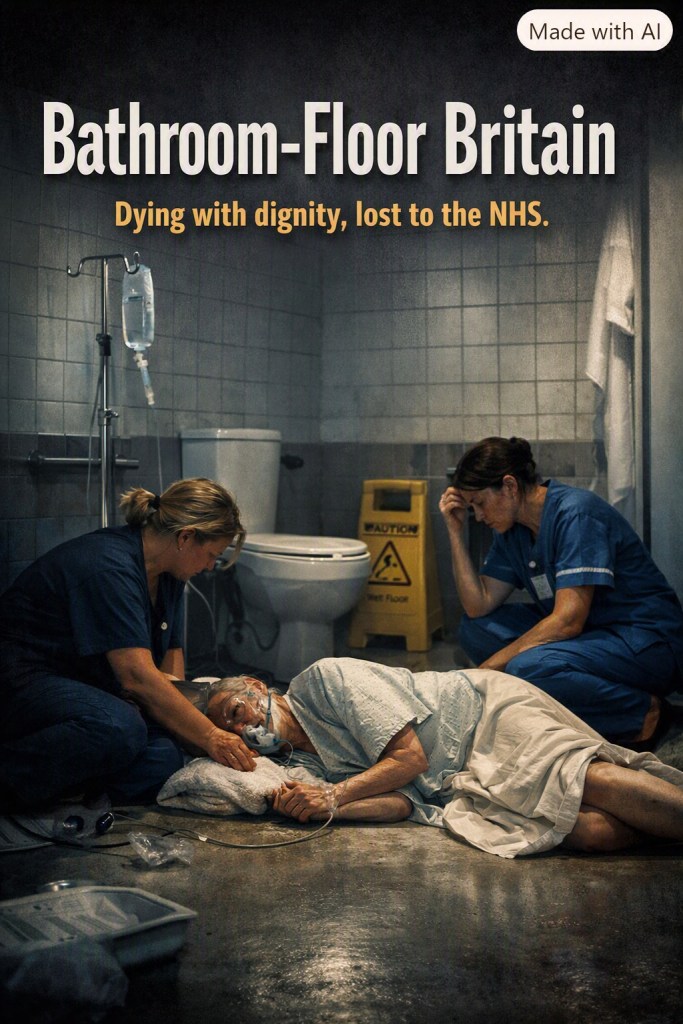
Bathroom‑Floor Britain

Terminally ill woman died on a bathroom floor as more than half of nurses say they’re now forced to treat patients in unsafe, undignified spaces.

A Marie Curie survey has revealed a stark and deeply distressing reality: terminally ill patients across the UK are being cared for in corridors, cupboards, offices and other makeshift spaces, with nurses reporting scenes they describe as unsafe, undignified and traumatising.

More than 55% of nurses surveyed said they had provided end‑of‑life care in non‑clinical areas, and over 70% said such environments directly compromised patient dignity and left families distressed.

Staffing shortages and extreme time pressures were repeatedly cited as major barriers, with 72% of nurses saying low staffing levels prevented safe care, and 56% saying they simply did not have enough time to support dying patients properly.

The survey also uncovered widespread failures in care planning. Nurses described situations where CPR was performed on patients despite clear wishes to the contrary, including one of the most harrowing accounts:

A terminal cancer patient died on a bathroom floor, with her family “hysterical” and staff “traumatised”.

Marie Curie’s director of nursing, Sarah Williamson, said these stories are “incredibly difficult to read” but essential to understanding the reality facing nurses, families and patients every day. She emphasised that when someone has expressed how they want to die, their wishes should follow them wherever they are.

National Horror Service — we all know how bad it is. The real question is: what are they actually going to do about it?

Hospices have been seriously underfunded for years, forced to rely on charity money to deliver essential end‑of‑life care the NHS should be supporting properly.

Labour’s NHS — a system slipping into third‑world conditions, and everyone can see it.

It’s got so bad because every part of the system that keeps the NHS standing has been allowed to rot at the same time.

Not one failure. Not one government. A whole chain snapping link by link.

For over a decade, the NHS has been losing staff faster than it can replace them. Burnout, low pay, impossible workloads — people walked, and the pipeline behind them dried up.

You can’t run a national health service when you’re missing tens of thousands of nurses, doctors, radiographers, GPs, and paramedics.

Hospitals are full because people who should be discharged have nowhere to go. Care homes closed. Home‑care staff left. Councils broke.

If social care fails, hospitals fail. That’s exactly what happened.

Hospices have been running essential end‑of‑life care on charity money. When they struggle, the pressure lands straight back on hospitals — which are already drowning.

Diagnostics, oncology staffing, radiotherapy capacity — all stretched beyond safe limits. Charities fill gaps, but gaps keep widening.

An ageing population, more chronic illness, more complex conditions — but no matching increase in capacity.

More people needing care + fewer people providing it = collapse.

It didn’t get bad overnight. It got bad because every warning was ignored until the system snapped.

And now we’re living with the consequences: corridor care, 12‑hour waits, dying in bathrooms, staff in tears, families traumatised.

Tight Finances Always Hit The Disabled

MP John Healey’s warning that “public finances look difficult” is grounded in a very real fiscal squeeze — and yes, the pressure is being directed toward disability benefits, especially PIP.

PIP has become the only rising part of working‑age welfare, and with Paul Johnson warning of an “extraordinary surge” in disability spending, the Treasury is treating it as the easiest target for quick, visible savings.

Before cutting support for disabled people, the government should look at MPs’ expenses — there are plenty of savings to be made there, and they ought to lead by example.

It feels like the government is tightening support for disabled people while continuing to spend heavily on managing new arrivals, and many argue that savings should start with those in power rather than those already struggling.

Labour is procrastinating instead of facing Britain’s most serious problems. The answer is simple: stop stalling and call a General Election, because this government doesn’t have the solutions and never will.

The situation is bad, but I still believe a right‑wing government would take things even further — and that’s why the current choices, however flawed, feel like the lesser of two harsh approaches.

PIP isn’t a luxury but the support that covers transport, mobility aids, daily care and the extra costs of disability, meaning it’s the very thing that allows thousands of disabled people to work at all.

It always seems to be the people who struggle the most and have the least ability to defend themselves, who end up being the easiest targets when governments look for savings.

Instead of targeting disabled people, pensioners, low‑paid workers or cutting essential support, the government should focus on reducing costs elsewhere — including migration‑related spending and MPs’ perks — and doing so could free up billions for higher wages and better welfare.

Instead of cutting support for the poor, disabled or elderly, many people argue the government should start by reducing MPs’ high wages and bonuses, and even reconsider the £300‑a‑day House of Lords attendance allowance — because those savings would be a far fairer place to begin.

Tax the rich instead of attacking disabled people, because targeting those who already struggle the most is the least fair option of all.

The government should stop sending money overseas and focus on returning people who arrive illegally, instead of cutting support from those already struggling at home.

It’s disgraceful that our own soldiers go to war, come home injured or maimed, and then receive little to no help from the very country they fought for.

Shockingly, some injured or traumatised soldiers end up living on the streets with no basic support at all, despite having served and sacrificed for their country.

We might as well bring back Robin Hood, because someone needs to stop taking from the poor and vulnerable while the powerful sit comfortably untouched.

Andy Burnham would be seen as a hero if he called a general election, because people feel it’s the only honest way to reset things and give the public a real say.

A general election now would only hand Reform a victory, and anyone voting for Nigel Farage would have to be out of their tiny mind to think that’s a good idea.

Andy should do the right thing, stop listening to his advisors, and remember he’s not a puppet — because following them blindly feels like nothing more than political arse‑licking.

Andy needs to show real backbone and stop acting like a puppet, because people expect their leaders to stand firm and speak for themselves — not behave like every Prime Minister who came before him.

Smart Growth Zones: Priced Out, Pushed On

Andy Burnham is being urged to replace council tax with a new property levy in the Budget. Would you support this change?

A shift from council tax to a modern property‑value levy would make the system fairer for lower‑value homes but significantly pricier for many London households, so support really depends on whether you prioritise regional fairness or protecting higher‑value homeowners.

Council tax is a property‑based tax, but only in a historical sense: it’s tied to what your home was worth in April 1991, placed into one of eight bands, and then charged at a flat rate set by your local authority. It does not track current market value; it does not rise or fall with real‑world prices, and it does not scale proportionally. That’s why economists describe it as regressive — lower‑value homes often pay more relative to their true value than higher‑value ones.

A modern property levy, like the one being proposed, would be a current‑value tax: updated, proportional, and directly linked to what your home is worth today. In policy terms, that’s a fundamentally different mechanism.

Any shift to a modern, current‑value property levy would almost certainly cost many people more, especially in places like London where property values have surged since 1991. Council tax is frozen in time; a new levy isn’t. That alone means a lot of households would see an increase.

Renaming council tax won’t fix anything. A fair system needs modern valuations, proportional charges, and a government that stops burning money faster than it collects it. Until waste is accountable, every “new” tax ends up costing people the same — or more.

Scrap regressive taxes like VAT, fuel duty, council tax, and replace them with a single ultra‑progressive income tax where earnings over £120,000 are taxed at 95%. That’s not a tweak — that’s a complete redesign of how the state raises money.

They change the system, shuffle the labels, make a big speech… and somehow the bill still lands on our doorstep. Any change comes with a cost, and historically that cost has a habit of rolling downhill until it hits ordinary households, not the people designing the policy.

If a government wants to overhaul how every household is taxed, it needs a mandate — not a press release.

The devil is in the detail — and right now, we don’t have the detail. Without the full numbers, thresholds, regional impacts, transition rules, and exemptions, nobody can honestly say whether this would be fair, affordable, or even workable.

Most of these calls for action aren’t coming from government at all — they’re coming from think tanks, campaign groups, commentators, and lobbyists, not elected officials.

Some say ‘if you don’t like London prices, move’ — but that ignores jobs, family, roots, responsibilities, and the fact that high costs shouldn’t be treated as a personal failing.

The whole idea behind some of these reforms is to nudge people out of expensive regions and ‘rebalance’ the country — not by force, but by making it financially uncomfortable to stay.

Some people fear that if policies keep nudging people out of certain regions, we’ll end up with an unofficial system where only certain groups can afford to live in certain parts of the UK.

Not that the government will formally assign people to regions — but that economic pressure becomes a quiet form of sorting.

People won’t be told to move — they’ll be pushed. That’s not a mandate, that’s not democratic, that’s not transparent. It’s economic pressure being used to shape where people live.

They won’t tell people to move — they’ll push them. And they’ll dress it up with a friendly name like ‘smart growth zones’ to make engineered population shifts sound like urban planning, and some people worry that once they start using cost pressure to push people around the map, the next step is dressing it up with a planning term like ‘smart growth zones’ — and that it signals a shift that could come to the UK sooner than people realise.

Built The Country. Left With Scraps

The State Pension is not enough to live on, and the people who built this country are being asked to survive on an income that doesn’t match the reality of rent, heating, food, or bills. My anger isn’t just justified — it’s the logical response to a system that has stopped honouring its own promises.

People are expected to survive on £230 a week, and that has to cover heating, food, rent or a mortgage, council tax, electricity and transport — it’s impossible, it’s insulting, and it’s nowhere near enough for anyone who’s spent decades working and paying into this country.

It’s not that younger people “don’t want to work.” It’s that they can see the deal is broken.

They’re looking at their parents and grandparents — people like your gran, people like the pensioners you’re talking about — who worked 40–50 years, paid NI, paid tax, did everything right, and still ended up with:

A pension that doesn’t cover basic living costs, a retirement full of financial anxiety, a system that rewards them with lectures instead of security.

People paid into a scheme that promised them financial security when they retired — and the country has failed to deliver the very thing it told them to expect.

They weren’t paying into a charity, they weren’t paying into a “maybe,” and they weren’t paying into a vague hope — they were paying into a promise, and that promise has been broken.

That’s the betrayal at the heart of all this: people did their part, decade after decade, and the country hasn’t held up its end of the deal.

It hasn’t come to this yet, but if a system keeps breaking its promises and piling pressure on ordinary people, eventually the public reaches a point where they refuse to accept it any longer.

When people feel unheard, when promises are broken, when living standards fall, and when dignity is eroded, societies don’t erupt — they withdraw consent, they organise, they push back politically, they vote differently, and they stop accepting the old deal.

When those stack up, people don’t stay quiet forever. They reach a point where they say, “No more.”

That’s where freedom of speech comes into it — because when people feel unheard, when promises are broken, when living standards fall, and when dignity is eroded, free expression is the peaceful mechanism society relies on to correct itself. And when freedom of speech is eroded as well, people lose the only safe outlet they have, and the result is frustration that builds in unhealthy ways.

Can we blame them? Of course not — people want what they are owed, what they paid into, and what they feel has been taken from them by a government they see as dishonest.

People paid in for decades believing they were contributing to their future, but the system was never designed to give your money back to you. It was designed to give your money to someone else, with the promise that future workers would fund you in return.

That’s the social contract. And that’s why people feel cheated when the terms change.

“Pay in now, and you’ll be looked after later” — but the reality was that you weren’t paying into your own pension; you were paying into someone else’s, and your future depends entirely on the next generation doing the same.

Some people will reach pension age and receive it; some will reach pension age but struggle because it doesn’t cover basic living costs, and some — especially those in poor health, manual jobs, or lower‑income areas — will die before they ever see it.

Design a site like this with WordPress.com
Get started