Lifelong Means Lifelong: Stop The Assessments

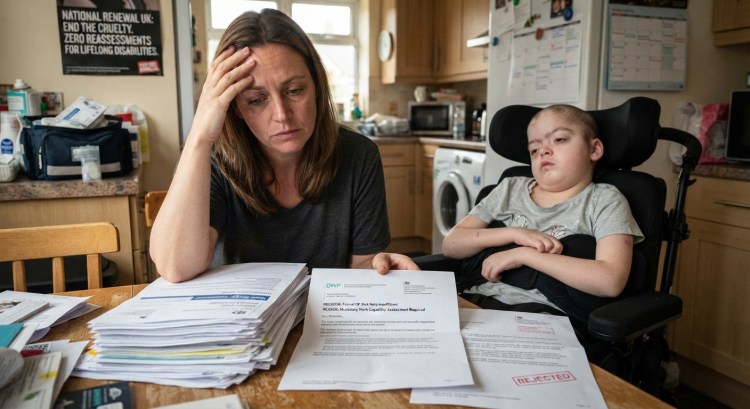
The Department for Work and Pensions (DWP) has sparked outrage after rejecting a formal GP sick note for 18-year-old Erin Devine—who requires round-the-clock care for lifelong conditions including microcephaly and cerebral palsy—and demanding she undergo a work capability assessment to claim Universal Credit.

Despite her complete lack of safety awareness and her absolute dependence on others for eating, drinking, and hygiene, the DWP dismissed 18-year-old Erin’s GP confirmation as “not enough” to spare her from a work capability assessment.

The stress of fighting the DWP’s bureaucratic red tape after they rejected her profoundly disabled daughter’s medical note has made full-time carer Lisa Devine physically ill.

Vulnerable families are being forced to navigate a gruelling cycle of securing rolling, short-term sick notes while trapped in a massive bureaucratic backlog, waiting months for formal work capability assessments just to confirm lifelong, unchanging diagnoses that clear medical evidence has already made blatantly obvious.

Erin’s stressful ordeal closely mirrors that of other families across Scotland, such as Connor Donnelly’s in Ayrshire, who have been dragged through exhausting administrative hurdles just to secure adult support as their severely disabled children turn 18.

The overwhelming stress of battling an unyielding welfare system is actively making full-time carers physically ill, pushing exhausted parents to their absolute breaking point as they fight unnecessary administrative red tape on behalf of their profoundly disabled children.

By treating a GP’s confirmation of a severe, lifelong neurological condition as insufficient evidence, the DWP exposes a hostile system built on suspicion rather than support, proving that its administrative framework relies on medical gaslighting by design to gatekeep essential welfare.

Instead of receiving proper state backing, families are expected to shoulder gruelling 24/7 care only to be met with relentless red tape, endless assessments, and aggressive administrative gatekeeping that reduces profoundly disabled individuals to mere problems to be managed by a cold bureaucratic system.

The DWP’s insistence that “supporting disabled people is our top priority” stands as the ultimate political hypocrisy when its actual operational framework routinely pushes vulnerable families into severe physical, emotional, and financial distress by forcing them to battle unnecessary bureaucratic hurdles for basic, life-sustaining support.

It is deeply unjust that full-time carers are compensated at a fraction of the National Living Wage—earning a weekly allowance that barely covers the cost of a single day at a commercial day care facility—while being forced to battle a redundant system where childhood Disability Living Allowance (DLA) fails to automatically transition to Universal Credit despite the unchanging, permanent nature of their children’s profound disabilities.

Public outrage continues to mount over how the system handles these transitions, as families and welfare communities express fierce criticism over the lack of automated data-sharing that forces parents to manually claim hidden Universal Credit elements, the disheartening pound-for-pound deduction of Carer’s Allowance from standard benefits, and the sheer financial hypocrisy of expecting families to provide round-the-clock specialised care for a tiny fraction of the National Living Wage while commercial day facilities charge more for a single day than a parent receives in an entire week.

Access To Work: Slashed By 85% With No Appeal

According to a BBC investigation, MPs and disabled people are reporting growing cases where existing support from the government’s Access to Work scheme is being reduced or taken away, with some individual awards slashed by up to 85% without a right to appeal.

An 85% reduction to an Access to Work award severely impacts a disabled person’s ability to earn a living, as these grants do not function as personal cash benefits but rather directly fund vital workplace adjustments like BSL interpreters and specialised equipment, meaning that slashing this support often leaves individuals physically or logistically unable to perform their duties and drives job retention down from 88% to 43% while ultimately costing the taxpayer more by removing employed individuals from the tax base.

Public comments and reactions regarding the disability benefit overhauls reflect widespread anxiety and fierce pushback, as individual claimants describe the current assessment process as a confusing and “dehumanising” ordeal that repeatedly forces them to prove lifelong illnesses while fearing that losing their awards will completely strip away their independence, a concern strongly echoed by advocacy groups like Disability Rights UK who warn that replacing flexible cash lifelines with restrictive alternatives treats disabled people as second-class citizens, while independent thinktanks like the Resolution Foundation caution the government that crude cuts targeting mental health conditions will yield minimal savings while actively driving people out of the workforce, a perspective that aligns with a strong broader public consensus showing that nearly half of the British public supports increasing spending on disability benefits while fewer than ten percent favor reducing it.

While the government-commissioned Timms Review has formally declared that PIP is “no longer fit for purpose” due to a dehumanising points-based assessment process that creates an atmosphere of fear and traps disabled people away from employment, a major report by the Resolution Foundation argues that the state can still fairly manage rising welfare costs and save up to £4.4 billion by 2030 through an improved functional assessment that explicitly discusses actual daily costs and targets support to those facing the highest real-world financial premiums, rather than relying on crude, condition-specific political cuts.

Abolishing the Work Capability Assessment and linking Universal Credit health elements entirely to PIP will create a high-stakes “all-or-nothing” gateway that—according to charities like Citizens Advice and the ME Association—threatens to strip away claimant autonomy through “alternatives to cash” like vouchers, while leaving hundreds of thousands of people with work-limiting conditions entirely without financial support.

The Department for Work and Pensions plans to completely abolish the Work Capability Assessment by 2028 to route all health-related financial support through a single PIP-based assessment gateway, a transition that data show puts claimants with physical mobility and fluctuating conditions—such as back pain, arthritis, and chronic pain syndromes—at the absolute highest risk of losing their awards because they face strict new requirements to score high points across a narrowed checklist of daily living activities, while current DWP statistics reveal that young applicants with conditions like ADHD, autism, anxiety, and depression are already facing the highest administrative rejection rates.

No Home, No Hope—Stranded By A System That Left A Disabled Man Behind

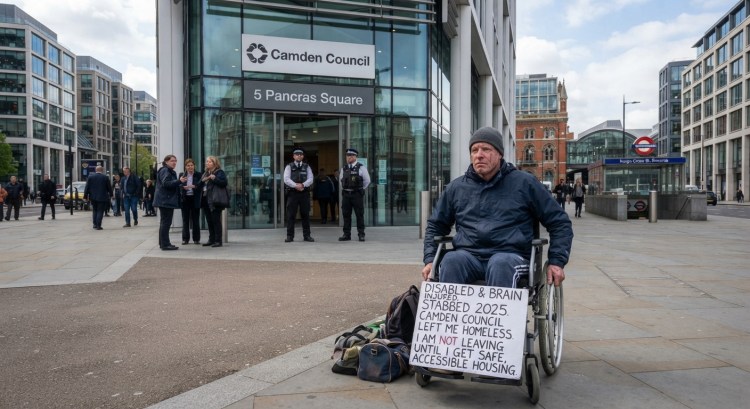
Bruce Lawrence Herry, a 52-year-old former martial arts teacher who sustained life-changing injuries and brain damage after being stabbed in the head in May 2025, staged a protest outside Camden Council’s headquarters by refusing to leave in his wheelchair until he was provided with safe, accessible housing, following months of being placed in unsuitable temporary accommodations across London, where he remains confined to a bed for 20 hours a day.

Bruce Lawrence Herry, a father of four who grew up locally attending the Rosary Primary School and St Aloysius’ College, expressed his deep despair by stating he “can’t take it any more,” explaining that while he is “no angel”, he does not deserve to be left disabled and without a carer while council officials treat his desperate housing situation like a joke.

Although Mr Herry’s severe, life-altering injuries and lack of a dedicated carer should place him at the highest priority tier under Camden Council’s Housing Allocation Scheme, he remains trapped in a bottleneck because the borough faces a massive deficit with over 8,000 households on the waitlist for only 600 annual lets, a crisis further worsened by the extreme scarcity of specialised wheelchair-accessible homes and rigid 28-day medical review processes that legally freeze an applicant’s ability to bid for any available properties while their case is being re-evaluated.

The fundamental breakdown in the system stems from a critical bottleneck where overall social housing is highly restricted—with over 8,000 households on Camden’s waitlist competing for just 600 annual lets—but the crisis is exponentially worse for disabled individuals because fully wheelchair-accessible properties are practically non-existent, forcing vulnerable applicants into an extremely rare, separate queue that averages a two-year waiting time.

Advocates for reform argue that systemic estate-wide audits are desperately needed to eliminate widespread tenancy fraud and reclaim unlawfully sublet social housing properties, which they believe would help free up vital ground-floor space for residents who are locked out of Camden Council’s points-based allocation system despite their deep local ties and critical medical requirements.

Managing this housing crisis operates exactly like a Rubik’s cube, because conducting mass estate-wide audits to evict illegal tenants would simply shift the crisis elsewhere without adding new stock, as the council would immediately become legally obligated to rehouse those newly displaced, evicted families in alternative emergency accommodation, thereby shuffling the same population around a broken system while failing to solve the fundamental problem that specialised, wheelchair-accessible homes are physically non-existent.

While the perception that small-boat asylum seekers receive priority over local residents causes widespread frustration, the hotels and temporary facilities used to house them are managed and funded entirely separately by the national Home Office, meaning they do not consume or impact Camden Council’s local social housing register, which strictly requires a multi-year local connection for permanent placements.

The systemic breakdown in the welfare state means that having complex or extra needs actually lengthens rather than shortens the wait for a permanent home, because the criteria for a safe property become so highly specific that disabled applicants are forced out of the general bidding pool and into a microscopic, stagnant market where specialised, wheelchair-adapted ground-floor units are practically non-existent.

Public commentary on the Bruce Lawrence Herry story reveals deep community divisions, with many residents expressing intense outrage at the council’s treatment of a vulnerable, disabled local stabbing victim, while others direct their frustration toward systemic issues like the nationwide shortage of accessible infrastructure and the perceived mismanagement of local housing lists.

Secure Your Status, Protect Your Future

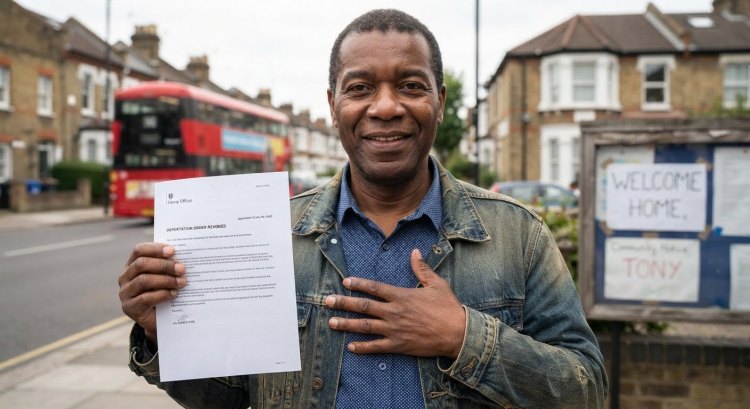
Following widespread public criticism triggered by a profile of his case in The Guardian, the UK Home Office has revoked the deportation order against Tony Hall, a 62-year-old London resident who arrived from Barbados in 1976 at the age of 12 as part of the Windrush generation, finally ending a 14-year threat of expulsion to a country he does not remember and where he has no surviving relatives.

The Windrush scandal is a British political crisis caused by the government’s 2012 “hostile environment” policy, which wrongfully classified thousands of legal, long-term Commonwealth citizens as illegal immigrants due to destroyed historical records, leading to mass job losses, evictions, denials of healthcare, and wrongful deportations.

While the Windrush Compensation Scheme has paid out over £127 million to nearly 4,000 claimants and introduced major 2026 reforms like advance payments and pension expansions, it continues to face fierce criticism for lacking formal legal aid, mirroring ongoing efforts by a newly appointed independent Windrush Commissioner to hold the Home Office accountable after it previously backtracked on key recommendations from the independent Wendy Williams Lessons Learned Review.

The Windrush Compensation Scheme allows families of deceased victims who arrived in the UK before 1973 to claim financial restitution for past hardships through a designated estate process, though the program still faces scrutiny, with roughly 8,500 claims outstanding or uncompensated out of nearly 12,000 total applications filed since its launch.

Submitting a Windrush deceased estate claim requires representatives to provide the victim’s death certificate, a grant of probate or letters of administration, and personal proof of identity, though the Home Office offers no fixed processing timelines due to varying case complexities.

This case serves as a heartbreaking reminder of the immense hardships faced by immigrants abroad, as exemplified by a child who arrived in a new country at the age of twelve only to endure fourteen years of agonising fear over being deported to a homeland they no longer remember and where they share no remaining family ties.

Academic studies like The Ties That Bind show that the hostile environment policy caused profound psychological trauma, prompting grassroots community organisations like Action for Race Equality to step in with initiatives like the “Healing Through Justice” project to provide vital legal advocacy and mental health support to affected families.

This poignant advice serves as a vital warning for prospective migrants, urging them to thoroughly understand immigration laws, prepare wisely, and secure their legal status rather than assuming a life abroad guarantees peace, while emphasising the crucial importance of never forgetting one’s roots, family, and identity.

Public commentary on cases like Tony Hall’s reveals a deep societal divide between advocates who condemn the prolonged threat of deportation as an inhumane, double punishment for a person who has already served their prison time, and critics who maintain that a serious criminal record justifies the stripping of a migrant’s right to remain.

This insightful perspective emphasizes that true success for migrants is not defined merely by reaching a destination like Europe, but by successfully building a stable, secure, and meaningful life through robust legal grounding, careful preparation, and a resilient connection to one’s heritage.

Community Stopped The Hate; Justice Handles The Rest

Abdisamad Siad, 33, of Islington, has been charged with three counts of assault by beating following a series of suspected antisemitic attacks on Jewish women in Stamford Hill, London.

On Monday, 19 October 2026, at approximately 13:40 BST, a man targeted multiple Orthodox Jewish women in the Clapton Common and Upper Clapton Road areas. CCTV footage captured him running up to a woman pushing a baby in a pram, pausing, and punching her twice in the head.

Three Jewish women reported being assaulted and sustained minor injuries, including significant facial bruising.

Volunteers from Shomrim, an independent Orthodox Jewish neighbourhood watch group, responded within 30 seconds of the initial report, witnessed the second assault, and detained the suspect until Metropolitan Police officers arrived at the scene.

Siad appeared at Highbury Corner Magistrates’ Court on Wednesday, 21 October 2026. A provisional trial date has been scheduled for 11 December at Stratford Magistrates’ Court.

In addition to the targeted hate crime charges in Stamford Hill, Siad has also been charged with grievous bodily harm (GBH) with intent regarding a separate, unrelated attack on another woman in Islington. The victim in that incident is believed to be known to him.

The Metropolitan Police are treating the Stamford Hill assaults as a suspected antisemitic hate crime and have deployed increased patrols to reassure the local community. London Mayor Sadiq Khan condemned the “despicable assaults,” reiterating that no one should face violence or abuse because of their faith.

Three Orthodox Jewish women came forward as victims after a man went on a violent spree in Stamford Hill, London, punching and slapping them in separate, suspected antisemitic attacks before being detained by local bystanders.

The intense public anger and condemnation following these violent, targeted assaults reflect the deep distress of a community seeking justice as the case now moves through the criminal court system.

While the Metropolitan Police confirmed that all three women fortunately avoided emergency hospitalisation by sustaining only minor physical injuries like facial bruising, local community support groups emphasise that the deep emotional shock and psychological trauma from the unprovoked attacks remain a significant focus for ongoing care and local reassurance.

The Metropolitan Police and local neighbourhood watch groups are actively providing ongoing pastoral care to help them recover from the severe emotional shock of the unprovoked assaults.

No woman should ever have to endure or fear such violent hostility, and the unprovoked, targeted nature of these physical assaults has rightly drawn widespread condemnation while reinforcing the vital responsibility of the justice system to protect individuals from hatred and ensure public safety for everyone.

Stopping targeted violence of this nature requires a multi-layered approach that bridges immediate local protection with broader societal prevention. In London, stopping hate crimes and violence against women combines specialised policing, community-led infrastructure, and targeted intervention strategies.

Relying on reactive policing is not enough; preventative, localised enforcement is required to stop attackers before they strike.

Because the suspect in this case targeted multiple women, specific anti-violence strategies are necessary to address the root causes of misogynistic and street-level abuse.

According to data compiled by independent monitoring groups and government reviews, the significant rise in attacks against Jewish people is driven by a combination of escalating geopolitical conflicts, the normalisation of extremist conspiracy theories online, and the high visibility of specific Jewish communities.

No innocent community should ever be forced to hide or alter how they live to stay safe, meaning the responsibility rests entirely on law enforcement and the justice system to proactively protect public spaces, deter offenders, and aggressively prosecute anyone who commits targeted violence.

The United Kingdom operates under a strict legal framework that guarantees freedom of religion and protects all individuals from discrimination and violence, regardless of their faith.

The effectiveness of the UK’s legal framework and social policies is a subject of ongoing debate, with critics and researchers pointing to a gap between statutory protections and the reality of rising hate crimes [CST Antisemitic Incidents Report 2025].

Sociological and polling data show that the vast majority of British Muslims view the UK as a good place to live and express a strong sense of national identity, though recent data highlights an emerging decline in their sense of social belonging.

Political analysts, social researchers, and intelligence experts hold varying views on whether domestic tensions and global conflicts will worsen, though data indicates that social friction in the UK remains highly volatile and tightly bound to external events.

Whether the conflict worsens depends heavily on the scale of international events, the effectiveness of police enforcement, and the ability of tech platforms to curb targeted online radicalisation.

Wales 2030: Truth On The ballot, Or You’re Out

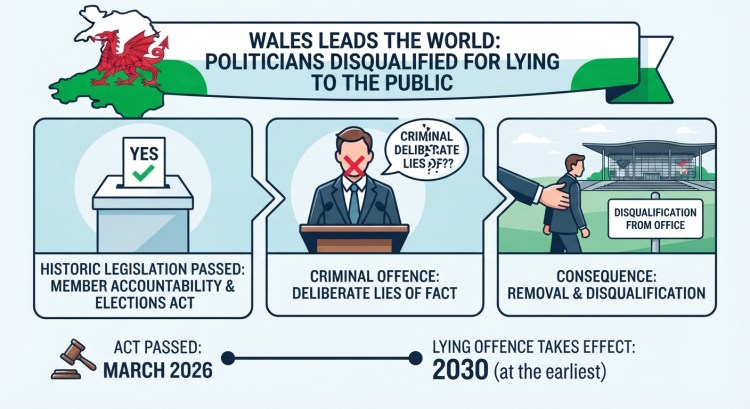
The Welsh Parliament has advanced historic legislation to disqualify politicians who deliberately lie to the public, though the rules are not expected to take effect until the 2030 election.

The Welsh Parliament passed the historic Member Accountability and Elections Bill on 17 March 2026, which officially became law upon receiving Royal Assent on 27 April 2026.

Under Section 24 of the Senedd Cymru (Member Accountability and Elections) Act 2026, Welsh Ministers are legally required to introduce a new criminal offence that prohibits the making or publishing of false or misleading statements of fact intended to affect the outcome of an election.

The criminal ban on political misinformation under the Senedd Cymru (Member Accountability and Elections) Act 2026 will not take effect until the 2030 election at the earliest, allowing ministers several years to legally define what constitutes deliberate deception.

Part 1 of the Senedd Cymru (Member Accountability and Elections) Act 2026 introduces an official recall system, allowing voters to petition and remove a Member of the Senedd between elections if they receive a short prison sentence or if the Standards of Conduct Committee recommends removal for serious misconduct.

Part 2 of the Senedd Cymru (Member Accountability and Elections) Act 2026 strengthens the standards process by creating a mandatory Standards of Conduct Committee that includes independent lay members, while giving the Senedd Commissioner for Standards new powers to launch investigations on their own initiative.

Under Section 20 of the Senedd Cymru (Member Accountability and Elections) Act 2026, the Senedd Commissioner for Standards is legally authorised to launch proactive investigations into a politician’s conduct on their own initiative, provided they have reasonable grounds to suspect a rules breach.

Serious misconduct can lead to a vote that kicks the member out.

Supporters of the Senedd Cymru (Member Accountability and Elections) Act 2026 have hailed the legislation as a ground-breaking milestone that will hold politicians to higher professional standards and help rebuild trust between the public and elected officials.

Critics of the legislation argue that criminalising political statements risks severely limiting free speech, chilling robust democratic debate, and dragging independent courts into highly politicised disputes over what constitutes an intentional lie.

On 17 March 2026, the Senedd overwhelmingly passed the Senedd Cymru (Member Accountability and Elections) Act 2026 by a vote of 50 to 1, with Reform UK MS Laura Anne Jones casting the only opposing vote.

Wales is not banning every political lie starting tomorrow, as the new criminal rules under the Senedd Cymru (Member Accountability and Elections) Act 2026 will not take effect until the 2030 election at the earliest.

By passing the Senedd Cymru (Member Accountability and Elections) Act 2026, Wales is putting a formal legal mechanism on the books that can permanently end a politician’s career if a deliberate lie of fact is independently proven and deemed serious enough to trigger disqualification.

Political observers, legal scholars, and democratic reform groups across the globe are closely watching Wales to see how this unprecedented accountability framework functions in practice and whether it successfully rebuilds public trust or inadvertently suppresses robust democratic debate.

Public opinion on implementing this law elsewhere remains deeply divided between supporters who believe it is a vital step toward rebuilding public trust and enforcing professional honesty, and critics who warn it risks chilling free speech, politicising the judiciary, and creating severe legal difficulties over how to fairly define a deliberate lie.

While members of the public enthusiastically praise Wales as a global trailblazer and call for similar rules worldwide, legal experts and political analysts express deep concern over how courts will fairly distinguish an intentional lie from a political opinion without inadvertently chilling free speech.

World War 3: Equal Rights, Equal Draft

If World War 3 happens, the UK could draft young, single women into the military, building on World War II precedents and strong public support for gender equality in wartime service.

The head of the British Army has warned that political leaders will soon tell the public they must make personal sacrifices to prepare for the growing threat of war.

The head of the British Army told Sky News that every citizen will be asked to make personal sacrifices to defend the country.

To lower high US fuel prices caused by a war with Iran, President Trump made a deal to buy Russian diesel while blaming Ukraine for the crisis and urging its leader to step down.

Although the UK has not used mandatory military service since 1960, rising threats from Russia have sparked debate about bringing it back to boost troop numbers.

Six months before World War II officially broke out in 1939, the UK began conscripting men aged 20 and 21 for military training.

By the end of 1941, the UK expanded conscription to older men and women, though women were drafted into supporting roles rather than frontline combat.

In the spring of 1939, rising international tensions forced Prime Minister Neville Chamberlain’s government to prepare for a potential war against Nazi Germany.

In May 1939, Parliament passed a law requiring around 240,000 young single men to register for six months of military training.

In December 1941, Parliament passed a law making all unmarried women and childless widows aged 20 to 30 liable for the draft.

The UK expanded national service in 1941 because too few volunteers were joining civilian defence and military support units.

Former Defence Secretary Grant Shapps stated that the world is entering a pre-war era, while General Sir Patrick Sanders urged for an expanded army to boost the nation’s readiness for conflict.

Conscription ended in the UK in 1960 when the last soldiers drafted under the National Service scheme were discharged.

During the 2024 general election, Conservative leader Rishi Sunak proposed a mandatory national service scheme for 18-year-olds, which the Labour Party dismissed as a gimmick.

A survey found that 38% of under-40s would refuse to serve in a new world war, and 30% would refuse even during an imminent invasion.

The same survey found that 72% of the public supports conscripting women alongside men if a military draft is introduced.

During World War II, people who refused to fight had to prove the sincerity of their beliefs before a special court to avoid military service.

Many experts fear that modern global conflicts have brought the world closer to World War Three than at any point since the Cold War.

There is no threat of an actual land war or invasion in the UK, but leaders warn the country is already facing digital threats like cyberattacks.

The UK government recommends that households stock a three-day supply of bottled water, tinned food, and battery-powered essentials to prepare for major emergencies.

Although most people believe a major crisis could happen, only a tiny fraction are actually stocking up on emergency supplies.

Many people ignore the advice due to high costs and scepticism, prompting the UK government to plan its largest home defence exercise in decades to test national resilience.

The Cabinet Office’s new campaign will teach households to handle blackouts, while a massive defence exercise secretly tests how officials respond to hostile sabotage.

While the UK government acknowledges that everyday financial survival is the public’s main focus, official resilience guidelines are meant to encourage those who can afford it to prepare so that emergency services can focus their limited resources on the most vulnerable during a crisis, a strategy that has drawn sharp criticism from charities who point out that millions of families facing soaring food costs have absolutely no extra money to build emergency stockpiles.

Public comments regarding the government’s preparedness advice range from deep scepticism and accusations of fearmongering to valid frustrations over the high cost of groceries, though some practical citizens are quietly building basic three-day emergency kits.

Dr Okolie: The Unapproved Clinician Who Worked In The Shadows

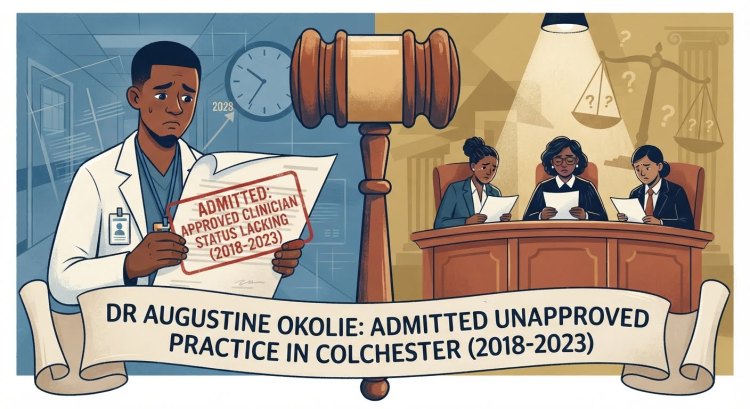
Dr Augustine Okolie has admitted to working as an Approved Clinician in Colchester without the required legal status between 2018 and 2023.

The specific medical facility in Colchester where Dr Okolie practised has not been publicly named in the official tribunal records.

A “fitness to practise” committee at the Nursing and Midwifery Council reviewed the case during hearings held between October 5 and 16, 2026.

The NMC panel is still considering whether Dr Okolie hid his lack of approval from his colleagues and managers.

The panel is still deciding if Dr Okolie deliberately lied to his peers and hid his true professional status.

Dr Okolie has admitted that he knew he lacked the required Approved Clinician status between 2018 and 2023.

The panel has formally proved these admissions.

The panel is still deciding whether Dr Okolie ignored a 2024 verification request and lied to a colleague about his approval date.

The NMC is deciding if his misconduct is serious enough to affect his fitness to practise.

The hearing was adjourned on Friday, October 16, before the NMC could make a full decision.

A new date to resume the hearing has not been set yet.

Danny Dyer: Nationalising The Flush, One Giant Poo At A Time

Actor Danny Dyer, alongside Labour MP Kevin McKenna, has delivered an SOS Whitstable petition signed by nearly 350,000 people to 10 Downing Street calling for the full nationalisation of the UK water industry, a move that followed a dramatic protest where they sailed a giant inflatable poo sculpture down the River Thames after Dyer witnessed severe sewage pollution firsthand while filming on the Isle of Sheppey.

The morning fog rolls over the muddy waters of the Thames. In the background, the Houses of Parliament loom majestically.

Suddenly, a modest charter boat cuts through the mist. Mounted proudly on the deck is a colossal, glistening, brown INFLATABLE POO SCULPTURE. It is magnificent. It is terrifying.

Standing at the bow, gripping the railing like George Washington crossing the Delaware, is DANNY DYER (50). He is wearing a high-vis jacket over a sharp designer coat, looking intensely into the middle distance.

Beside him stands LABOUR MP KEVIN MCKENNA, looking slightly terrified, holding a giant clipboard.

DANNY

(To the open water, deeply emotional)

Look at it, Kev. Just look at it. Bobbing along. Pure poetry, mate. It’s a proper statement.

KEVIN

(Nervously adjusting his glasses)

It’s certainly… large, Danny. Do you think the Prime Minister can see it from the window?

DANNY

See it? You could see this magnificent turd from outer space, Kevin! Neil Armstrong would look down and say, “Hold up, Buzz, what’s that proper pony floating past Big Ben?” It’s art, mate. Direct action.

A flock of seagulls circles the inflatable. Danny points a dramatic finger at them.

The protest, organised alongside campaign group SOS Whitstable, culminated in Dyer marching up to the steps of 10 Downing Street to hand-deliver a petition signed by nearly 350,000 citizens. The document demands the immediate nationalisation of the UK water industry, or, in the vernacular of the campaign’s chief spokesperson, “sorting out this proper pony state of affairs before the sea turns entirely into gravy”.

Dyer’s sudden pivot to ecological activism reportedly began while filming his caravan documentary on the Isle of Sheppey. While standing on the shoreline, the actor reportedly smelled a “distinct twang in the air” and realised that British beaches had become entirely “naughty”.

Inside Number 10, the political response was masterfully non-committal. A government spokesperson assured reporters that the Prime Minister wants to see “greater public control” over the water sector, though they stopped short of full public ownership. Political analysts interpret “public control” as a strategic middle ground where the government can look disappointed at water companies without actually having to pay for the pipes.

Meanwhile, Thames Water lenders and executives have expressed deep concern over the stunt, warning that making decisions based on giant river-bound emojis could destabilise the delicate economic balance of charging customers 40% more to swim in sludge.

At press time, political commentators were predicting that if the government does not act soon, Dyer’s next protest will involve a twenty-foot inflatable un-flushed toilet dropped directly down the Downing Street chimney.

The British public warmly embraced the stunt, with thousands demanding “Danny for PM” while noting that sailing a giant inflatable turd down the Thames was the first time a politician had ever accurately represented the state of the nation’s plumbing.

Create your own website, free on WordPress.com.Create your own website.
Start free