Lab-Grown Chocolate: Crafted In A Lab, But Made For Your Taste Buds

Cadbury’s parent company, Mondelēz International, has partnered with biotech startup Celleste Bio to produce prototype chocolate bars using cell-cultured cocoa grown in a laboratory.

Lab-grown foods are generally considered safe because they undergo rigorous regulatory approval and are produced in sterile environments, though experts continue to study potential risks like bioreactor contamination and long-term consumption impacts.

Lab-grown chocolate tastes and melts remarkably like the real thing because it is biologically identical, though early versions lack the complex flavour nuances that come from natural soil and farm fermentation.

While no multi-decade human data exists yet, the long-term effects of eating lab-grown chocolate include potential benefits like the total elimination of heavy metals and maximised heart-healthy antioxidants, though scientists are still studying how growth-liquid residues might affect human metabolism or the gut microbiome over time.

Lab-grown food is not automatically considered a GMO, as it is only labelled as such if the parent cells were intentionally gene-edited or genetically engineered during the production process.

Public opinion on lab-grown foods is sharply divided, with supporters praising its environmental benefits and ethical, slaughter-free production, while sceptics express deep concern over its high costs, the lack of long-term health data, and the rise of unnatural, ultra-processed food.

We actually need lab-grown foods to reliably feed a skyrocketing global population while eliminating the massive deforestation, carbon emissions, water shortages, and supply chain vulnerabilities caused by traditional agriculture.

Lab-grown food production requires highly advanced, pharmaceutical-grade infrastructure centred around massive steel bioreactors, sterile cleanrooms to prevent contamination, complex filtration networks, and a massive, continuous supply of clean water and electricity.

The heavy electricity and infrastructure demands of lab-grown food production significantly impact carbon emissions, meaning that if a facility relies on a fossil-fuel-dominated energy grid, its carbon footprint can actually end up higher than that of traditional agriculture.

Relying on fossil fuels to power lab-grown food facilities does defeat the core environmental purpose of the technology, which is why scientists stress that these products can only truly deliver on their green promises if the entire production infrastructure is powered by 100% renewable energy.

Critics and environmental researchers agree that advertising current lab-grown foods as an instant “green solution” borders on greenwashing, because companies often publicise the long-term, theoretical benefits of the technology while downplaying the massive fossil-fuel footprint required to run their actual, present-day factories.

When looking at the gap between corporate marketing and reality, the pattern of companies hyping up “eco-friendly” solutions while hiding a massive fossil-fuel footprint happens across almost every major industry today.

Public comments online reflect a deep-seated frustration with corporate “greenwashing,” with many people viewing lab-grown foods as a dystopian, overly processed con that masks a massive industrial carbon footprint under the guise of saving the planet.

The exact “Not In My Backyard” (NIMBY) sentiment is why lab-grown food companies face intense public resistance, as local residents rarely want massive, noisy, and potentially foul-smelling industrial bioreactor plants operating near their neighbourhoods.

System Broken, People Breaking: Step Back And Reclaim Control

The world feels incredibly heavy right now due to skyrocketing costs, global conflict, and a political system that feels entirely disconnected, making it completely understandable to feel overwhelmed and angry.

With major conflicts in the Middle East and Ukraine driving global economic instability and humanitarian crises, the relentless coverage of real-time warfare can make it feel like the entire world is fractured and on fire.

A profound sense of abandonment, exhaustion, and anger is gripping communities where families must work themselves to the bone just to afford food, all while grappling with the visible strains of violent crime, irregular immigration, and a political system that feels entirely disconnected from their struggle.

The UK is gripped by an acute systemic crisis as families work relentlessly against punishing energy costs and record-high inflation, while a public sector burdened by a staggering £3 trillion debt and collapsing services leaves communities feeling entirely abandoned by the political system.

Ordinary people feel an intense frustration as they self-censor their views online and in the workplace out of fear of legal repercussions or job loss, creating a profound sense that the freedom to speak one’s mind has been deeply restricted.

Faced with a world that feels increasingly out of control, people are gripped by profound exhaustion and fear as they watch their security erode and wonder how they can possibly build a stable, decent future for themselves and their children.

It is deeply devastating that the overwhelming weight of these crises is driving some to absolute despair, but if you or someone you know is reaching a breaking point, please know that free, completely confidential support is available 24/7 by calling Samaritans at 116 123 or texting SHOUT to 85258.

Many people feel a deep longing for a time when hard work was rewarded, communities felt safe, and there was a genuine, shared belief that the future would be better than today.

That profound desire to rebuild, restore pride, and bring communities back together is a powerful reminder that even in the darkest times, the determination to give the next generation a future worth fighting for remains entirely alive.

At its core, this struggle is entirely about the human toll on families and millions of ordinary people who are deeply exhausted by a relentless cycle of financial strain, anxiety, and a profound sense of being completely abandoned by the institutions meant to protect them.

People fundamentally deserve a life defined by security, dignity, and a genuine belief in the future, making systemic change absolutely vital before the collective sense of hope is completely exhausted.

Across social media, community forums, and talk radio, ordinary people’s comments echo a profound sense of exhaustion and anxiety, reflecting a widespread belief that the country is breaking down under the weight of surging costs, violent crime, and an elite political class that remains entirely indifferent to their struggles.

Prep For Three Days, Or Be Left In The Dark

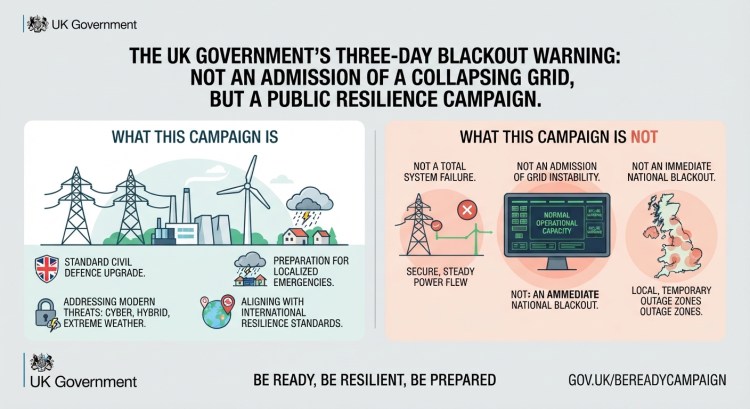
The UK government’s new three-day blackout warning isn’t an admission of a collapsing grid, but a public resilience campaign to prepare households for localised emergencies caused by extreme weather, cyber threats, and modern infrastructure challenges.

The shift toward a fragile, hyper-digital, “just-in-time” society has created structural vulnerabilities to cyber warfare and grid instability, prompting governments to adopt a distributed-resilience strategy that relies on citizen preparedness to prevent centralised emergency services from being overwhelmed during a systemic crisis.

The view that these campaigns represent a government failure underscores a stark reality: by advising citizens to stockpile supplies, the state acknowledges that its hyper-digital infrastructure is vulnerable to rapid disruption and is shifting the initial burden of survival onto households to prevent centralised emergency services from being instantly overwhelmed by a crisis.

The factual data reveals two valid interpretations: either these warnings are a stark admission that government infrastructure has been left dangerously vulnerable to modern threats, or they represent a pragmatic, standard civil-defence strategy to ensure communities can survive the initial shock of a major disruption.

When faith in public institutions is entirely gone, these warnings are viewed as a profound breach of the social contract: an admission that after years of tax-funded mismanagement, the state cannot protect its citizens from predictable infrastructure failures and is offloading the burden of basic survival onto individual households before a crisis even hits.

The view that infrastructure warnings and geopolitical tensions are a managed experiment mirrors a deep distrust of institutional power, suggesting that governments use a continuous crisis narrative and the threat of conflict to enforce public compliance, distract from catastrophic national debt, and implement sweeping economic resets that exploit everyday citizens.

Choosing not to prepare is a direct rejection of constant crisis narratives, reflecting a widespread fatigue with institutional scaremongering where people prioritise daily peace of mind over a hypothetical emergency that they feel uses fear to shift accountability away from the state’s own infrastructure failures.

While supply chains proved highly adaptable during the pandemic because core utilities remained fully operational, a major cyber-attack or grid failure presents a completely different structural threat by instantly taking down the electricity, digital communication, and payment networks that supermarkets absolutely rely on to restock shelves and process sales.

The concern that official warnings will fuel public anxiety is well-founded, as publicly advising citizens to stockpile provisions risks creating a self-fulfilling prophecy where fear of shortages triggers immediate panic-buying and artificial shelf-emptying long before any actual emergency occurs.

Public reactions to the campaign reveal a deeply polarised response: while critics and low-income families brand the guidance as a “tone-deaf” insult to those who cannot afford extra provisions, thousands of fearful citizens have immediately panicked, driving massive sales surges for tinned food, bottled water, and emergency tech across the country.

Welfare Or Workfare: Fair Contribution Or Modern Exploitation?

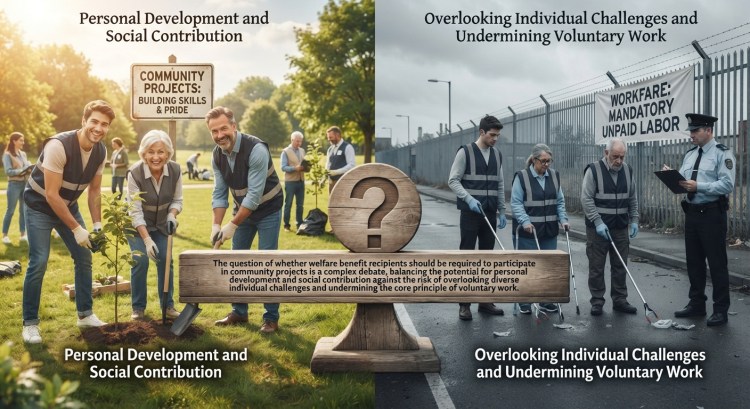
The question of whether welfare benefit recipients should be required to participate in community projects is a complex debate, balancing the potential for personal development and social contribution against the risk of overlooking diverse individual challenges and undermining the core principle of voluntary work.

Transitioning community service programs into paid public works projects would offer standard wages and employment rights instead of forcing recipients into unpaid tasks.

While welfare advocates and labour organisations view mandatory unpaid community work as a coercive and exploitative system that people are forced to accept for basic survival, proponents argue it is a reciprocal social contract designed to provide work experience and civic routine.

Under proposed community work programmes, benefit claimants are typically assigned to manual, clerical, or public service tasks such as environmental cleanups, public property maintenance, and administrative assistance in local libraries and charities.

The paradox of work being available for public service but not as paid employment is a central criticism of workfare programs, highlighting the economic debate between using welfare recipients for unpaid maintenance and funding regular, paid public sector jobs.

The argument that claimants performing mandatory work should receive a standard wage packet, pension contributions, and full employment rights is championed by labour unions who view the tasks as standard employment, whereas opponents maintain these schemes are a temporary condition of state support intended solely for employability training.

Opponents argue that basic public service tasks do not offer genuine technical skill-building for claimants, whereas proponents maintain that the true value lies in cultivating foundational soft skills, establishing a daily routine, and securing a recent work reference.

Opponents frequently point out that the sudden availability of these community tasks proves that essential public work exists and needs doing, arguing that the government should fund these duties as proper, paid employment rather than packaging them as an unpaid requirement for receiving welfare.

While critics and human rights advocates argue that conditioning essential welfare benefits on mandatory, unpaid labour meets the ethical definition of forced labour, courts have ruled that these programs do not legally constitute modern slavery under international treaties because they are categorised as civic training rather than systemic exploitation.

The perspective that mandatory workfare is a form of modern slavery remains a powerful ethical critique among welfare activists, who maintain that any system forcing individuals to perform unpaid labour under the threat of losing basic survival income is inherently coercive, regardless of how governments or legal frameworks officially classify the programs.

Public commentary on mandatory workfare reveals a stark division: grassroots activists and labour unions condemn the schemes as exploitative, coerced labour that replaces real jobs, while government officials defend them as essential skill-building programmes legally distinct from forced labour.

Fighting For Access Is An Unpaid Full-Time Job

The desire to live in a place where you feel genuinely valued, safe, and supported is completely valid. It is incredibly exhausting to fight for basic dignity, infrastructure, and respect.

While no country has a flawless record, certain nations have built their societies around robust welfare systems, universal design, and legal frameworks that view disability support as a fundamental human right rather than a burden.

The UK offers robust financial aid through PIP and free healthcare via the NHS, but its social care system faces greater funding strains and less uniform physical accessibility than the Nordic nations.

While the UK mandates accessibility legally and offers free bus passes and train assistance, systemic underfunding and broken station lifts leave 92% of disabled travellers facing regular travel barriers.

The UK could dramatically improve by replacing loose “reasonable adjustments” with mandatory accessibility audits, fully funding train station lift upgrades to unlock economic potential, and simplifying the stressful, bureaucratic benefit assessment process.

Being stranded in a wheelchair due to failed Passenger Assist is a terrifying and unacceptable reality on British Rail, driven by systemic communication breakdowns and staff shortages that have recently forced high-profile figures and everyday passengers alike to crawl off trains without help.

Replacing manually deployed metal ramps with automated, on-board electric gap-fillers is the ultimate solution for independent travel, but the UK’s inconsistent Victorian platform heights and slow fleet upgrades mean this technology is only available on a fraction of newer networks.

It is a profound and frustrating paradox that our society has automated everything from banking to driving, yet still forces disabled passengers to rely on a broken, manual ramp system that routinely strands them on trains.

The London Underground cannot simply be torn out and replaced because it is tightly webbed beneath a densely populated city, forcing engineers into a slow, multibillion-pound process of retrofitting lifts and digital systems around complex, 160-year-old subterranean infrastructure.

To navigate a failing network, disabled passengers are legally and practically forced to use workarounds like demanding free alternative accessible taxis under official policies, using “Turn Up and Go” services, and weaponising the independent Ombudsman system for financial compensation when assistance fails.

Upgrading trains with automated electric gap-fillers and mechanical ramps is the only way to eliminate the barrier of staff-dependent travel, a vital necessity that is finally being addressed by new rail mandates requiring all future train fleets to integrate unassisted level boarding as a standard baseline design.

Replacing steep, stepped escalators with continuous, flat passenger conveyors (often called travelators or moving walkways) would allow small wheelchairs and mobility scooters to seamlessly transition between station levels without waiting for lifts, but the safety and space constraints of the UK’s deep subterranean transit networks make large-scale installation structurally unfeasible.

While installing inclined moving walkways could physically be done in brand-new, modern stations built from scratch, doing so within the existing subterranean network would require demolishing entire neighbourhoods to dig the massive, shallow tunnels they require.

While it is true that modern engineering can solve almost any problem given enough time and money, the government and transport operators choose to invest in vertical lifts instead of long moving walkways because lifts require a fraction of the space and budget while delivering the exact same step-free independence.

Ultimately, the choice to install vertical lifts instead of massive moving walkways comes down entirely to saving money and squeezing the absolute maximum out of limited taxpayer budgets to make as many stations step-free as possible.

London is a beautifully vibrant city, but navigating its complex, centuries-old transit system in a wheelchair can turn a simple day out into an exhausting, stressful hurdle race.

It is incredibly exhausting, and you shouldn’t have to be a strategist, a lawyer, and an engineer just to cross town or go to the shops.

Poppy Ban Myth: Common Sense Lost To Corporate Red Tape

JD Wetherspoon does not ban poppies; a viral video from an incident on 25 October 2026 was caused by an individual security guard mistakenly turning away a veteran during local protests in Gosport.

Here is the official statement from JD Wetherspoon condensed into a single sentence:

“Wetherspoon has been a long-standing supporter of the Royal British Legion Poppy Appeal, with poppies for sale in our pubs, including The Star; there is no ban on poppies in Wetherspoon pubs; however, there were some standard security measures in place today, as a result of demonstrations in the town, and unfortunately, some members of the public, including some wearing poppies, did not gain entry to the pub.”

While JD Wetherspoon claimed it closed the pub early on police advice, Hampshire and Isle of Wight Constabulary explicitly said it did not advise any venues to shut down, noting that independent security decisions were instead prompted by pre-planned dispersal powers used to manage local protests.

The footage captured an overzealous security guard misinterpreting corporate neutrality rules by aggressively treating a symbol of remembrance as a political statement, ordering a veteran to hide the poppy or face ejection from the venue.

JD Wetherspoon has not publicly confirmed whether the security guard was sacked, as the company’s official statements have focused on issuing an apology rather than disclosing specific disciplinary actions taken against their agency door staff.

Rather than overruling the doorman’s mistake, the pub manager backed up the security guard’s decision at the door, drawing heavy online criticism for failing to step in and correct the error.

The incident sparked widespread public outrage and reflections on deep cultural tensions, with many viewing the bouncer’s actions as a symptom of a hyper-cautious corporate culture that has lost all common sense in its fear of causing political offence.

When common sense vanishes under the weight of corporate red tape and high-tension politics, a simple act of remembrance becomes a viral national controversy.

For many people, incidents like this trigger a deeper concern that traditional British identity and sovereignty are being gradually eroded by extreme corporate neutrality and a fear of causing political offence.

Many feel a deep sense of cultural loss as traditional heritage and values seem to be sidelined by a hyper-cautious corporate culture that prioritises avoiding offence over honouring history.

Work Till 67, Or Die Trying

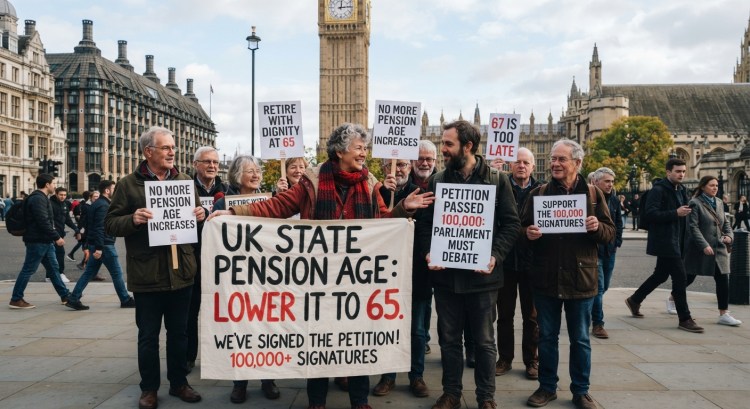
An online petition calling for the UK State Pension age to be lowered to 65 has passed 100,000 signatures, officially triggering consideration for a parliamentary debate despite the Government stating it has no plans to lower the age from its current trajectory toward 67.

The UK State Pension age is currently rising from 66 to 67, a phased transition taking place between 6 May 2026 and 6 April 2028 that applies to anyone born after 5 April 1960, establishing a flat state retirement age of exactly 67 for those born between March 1961 and April 1977.

While the majority of people are statistically projected to reach their pension based on average lifespans, approximately 1 in 7 UK adults currently die before reaching retirement age, and the average healthy life expectancy is just 60.7 years, meaning thousands of people are forced to spend their final working years in poor health or pass away before ever receiving a single penny of state support.

The UK’s sharp geographical postcode lottery means that while people in affluent southern areas like Richmond can expect to live in good health past age 70, those in deprived areas like Blackpool or the North East see their healthy life expectancy plummet to between 50 and 57 years, forcing them to endure up to 17 years of chronic illness before reaching the State Pension age of 67.

Historically, the UK State Pension age was never 60 for everyone; rather, from the inception of the modern system in 1948 until 2010, it was set at 60 for women and 65 for men, before subsequent legislation equalised the retirement ages for both sexes and began the gradual climb toward 67.

The current trajectory of the UK State Pension age is the result of a sequence of laws passed by successive governments, beginning with John Major’s Conservative government passing the Pensions Act 1995 to equalise the age at 65, followed by Tony Blair’s Labour government introducing the rise to 67 and 68 in the Pensions Act 2007, and finally David Cameron’s Coalition government accelerating that timeline through the Pensions Acts of 2011 and 2014.

When a person dies before reaching retirement age, the National Insurance contributions they paid are completely absorbed by the government to fund current public spending because there is no personal pot of cash to refund or pass down, though a surviving spouse or civil partner may be eligible to inherit a portion of their State Pension entitlement under very strict, limited conditions.

While the dynamic of individuals dying early effectively acts as a structural financial offset for the state, the government is not accumulating a fortune or a surplus because National Insurance operates strictly as a pay-as-you-go tax system where current contributions are immediately wiped out by the UK’s massive £146 billion annual State Pension expenditure, a bill driven higher by a rapidly ageing population.

The comparison to a Ponzi scheme is frequently made by critics because the UK State Pension relies entirely on using money from new entrants (current workers) to pay off older participants (current retirees) rather than investing the money to grow real assets, though it differs fundamentally through its public transparency, legal framework, and the government’s power to alter tax rates or eligibility ages to keep the model functional.

While private Ponzi schemes are strictly illegal because they rely on fraud, hidden accounting, and deceptive promises of guaranteed returns, the UK State Pension is entirely lawful because it is a transparent social contract established by Parliament and backed by statutory taxation powers, allowing the government to legally adjust tax rates, National Insurance contributions, and eligibility ages out in the open to keep the system financially viable.

While HM Treasury holds the executive responsibility for balancing the UK’s books and allocating budgets, the actual verification of public spending is conducted by the independent National Audit Office (NAO), which systematically scrutinises the accounts and reports directly to the House of Commons’ Public Accounts Committee to ensure public funds are handled lawfully.

The auditing process itself is entirely legitimate and independent, as the National Audit Office routinely exposes, investigates, and heavily criticises accounting errors, project failures, and billions in government waste across all civil service departments without political interference.

While MPs do not receive outright free personal meals or private property, their political roles are financially supported because the House of Commons provides a multi-million-pound annual catering subsidy to lower dining costs in Westminster bars and restaurants, alongside an accommodation allowance that fully covers the rent, utility bills, and hotel costs for non-London MPs needing a second home to attend Parliament.

The argument that MPs receive too much money is a widespread public concern, with critics pointing to their £91,346 basic annual salary, extensive taxpayer-funded expense packages, and lucrative outside business opportunities as being heavily out of touch with the financial realities of ordinary citizens.

This deep frustration highlights a widely held public view that the vast difference in wealth, housing perks, and secure pension arrangements creates an ideological bubble, preventing politicians from truly understanding the severe impact their policy decisions have on everyday families struggling with the cost of living and a rising retirement age.

This fundamental representation gap is heavily backed by data, showing that while 60% of the UK public identify as working-class, only about 5% of sitting MPs come from manual or routine occupations, meaning the vast majority of lawmakers lack personal lived experience of economic hardship and must instead rely on local constituency surgeries or civil service statistics to comprehend how their welfare and pension choices impact daily lives.

Whether individual MPs genuinely care is a subject of heavy debate, as academic surveys reveal that while many backbench politicians are deeply driven by public service and spend hours handling thousands of desperate local casework files, a severe structural divide remains because a politician’s capacity to act is heavily limited by their party’s voting rules, corporate lobbying, and a personal lack of working-class lived experience.

History Repeats, Legacy Remains

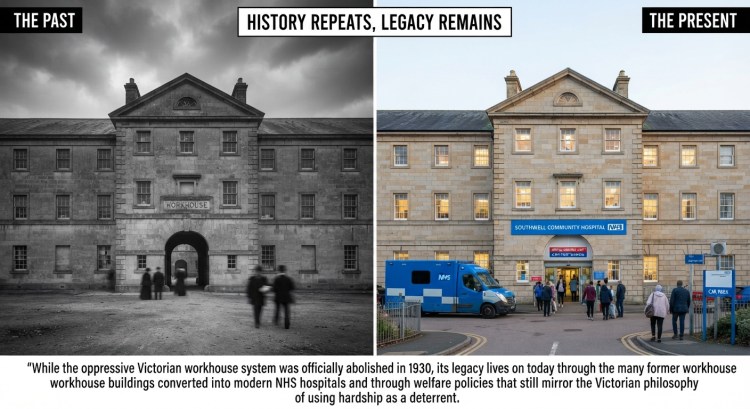
While the oppressive Victorian workhouse system was officially abolished in 1930, its legacy lives on today through the many former workhouse buildings converted into modern NHS hospitals and through welfare policies that still mirror the Victorian philosophy of using hardship as a deterrent.

Bringing back physical workhouses today is legally and politically impossible due to human rights laws against forced labour, the immense financial cost of running residential institutions, and massive public backlash, though critics argue their harsh philosophy of using discomfort as a deterrent already exists within the modern welfare system.

The resurrection of a workhouse system is legally blocked by Article 4 of the UK Human Rights Act and the European Convention on Human Rights, alongside International Labour Organisation treaties, which strictly prohibit slavery, servitude, and forcing vulnerable citizens into compulsory labour.

While the UK Parliament could technically change domestic law with a simple majority vote, doing so would require dismantling the country’s constitutional framework, tearing up the Good Friday Agreement, and completely withdrawing from major international treaties like the European Convention on Human Rights and United Nations labour conventions.

While the UK Parliament can pass ordinary emergency laws in a matter of days, changing fundamental human rights treaties to reintroduce workhouses cannot happen at the drop of a hat because it would instantly trigger constitutional delays in the House of Lords, massive domestic court battles, and the immediate collapse of international trade agreements.

While history proves that no political or legal system is permanently unchangeable, resurrecting an institution as extreme as the Victorian workhouse would require an unprecedented collapse of modern democracy and a complete rewrite of global civilisation’s moral and legal rules.

The sudden arrival of the cost-of-living crisis proves that massive economic and social shocks can blindside an entire society, demonstrating why we can never say never to radical systemic shifts over time.

While nobody expects a return to medieval sanitation or Victorian workhouses anytime soon, the unpredictable nature of history proves that modern systems are fragile, and anything remains possible when catastrophic societal collapse occurs.

Just like fashion cycles bring back styles once thought permanently outdated, historical trends and social structures often repeat themselves when similar economic pressures and human behaviours resurface across generations.

Evict Abusers, Empower Tenants

On Wednesday, 21 October 2026, Housing Secretary Angela Rayner announced strengthened social housing rules under Prime Minister Andy Burnham’s government, introducing new protections for domestic abuse survivors, expanding local authority powers to retain housing stock, and simplifying repair processes for tenants.

Under the Burnham government’s new shake-up, domestic abuse survivors will be protected in social housing law for the first time without being forced to flee, while the abusers themselves face direct eviction.

Under new amendments to the Social Housing Bill, the law change will stop survivors from having to prove abuse again where a protection order is already in place, while simultaneously introducing a simpler “Right to Manage” framework for council tenants, extended local notification periods to preserve social housing stock, and a new duty for public services to collaborate on preventing homelessness.

While the Social Housing Bill amendments enter the House of Commons Committee Stage on 27 October 2026 for a legislative process concluding on 3 November, the parallel “Right to Manage” rules will give council tenants an immediate legal mechanism to take over their own maintenance and repairs whenever a housing provider fails to meet adequate standards.

Council tenants can legally trigger the Right to Manage process by forming a Tenant Management Organisation (TMO) that must pass a competence assessment, win a majority resident vote, and sign a formal contract to strip failing local councils of their day-to-day repair and maintenance duties.

Under the updated framework, Tenant Management Organisations can legally assume responsibility for day-to-day estate repairs, rent collection, and grounds maintenance, but starting 1 April 2027, they will also face strict public transparency requirements under an extension of the Freedom of Information Act.

The new tiered governance framework adapts to different-sized Tenant Management Organisations by scaling compliance demands based on risk and complexity, while a mandatory 30-calendar-day legal deadline forces these groups to disclose requested housing management data or face immediate intervention from the Housing Ombudsman starting 1 April 2027.

If a Tenant Management Organisation fails to meet its information deadlines under the new transparency rules, the Housing Ombudsman holds the power to issue formal failure orders and publicly name non-compliant groups, while severe or systemic failures are immediately escalated to the Regulator of Social Housing for formal regulatory penalties.

If a Tenant Management Organisation denies an information request, residents can challenge the decision through a two-stage internal review process that the group must complete within 20 working days before the tenant can legally escalate the dispute to the Housing Ombudsman for a final, independent determination.

Because the Housing Ombudsman’s online portals and case tracking are offline due to a confirmed October 2026 cyberattack, residents facing stalled complaints must bypass the digital routes by calling 0300 111 3000 or emailing info@housing-ombudsman.org.uk to force manual processing of their cases.

To combat severe backlogs driven by a 500% explosion in case volumes since 2021, the Housing Ombudsman is actively hiring 80 additional caseworkers under its 2026/27 business plan to rapidly expand its understaffed workforce and accelerate dispute resolution times.

To accelerate case resolutions under its 2026–27 Business Plan, the Housing Ombudsman has enforced strict new targets to determine 90% of high-risk cases within four months, while simultaneously launching a three-stage intervention process that forces underperforming social landlords to fix recurring damp, mould, and repair failures before they escalate.

To fund its newly expanded caseworker workforce, the Housing Ombudsman is levying an increased annual fee of up to £9.73 per home on social landlords, while providers that fail the watchdog’s strict three-stage intervention process face formal Complaint Handling Failure Orders and public naming-and-shaming campaigns.

The Housing Ombudsman will issue a formal Complaint Handling Failure Order against a landlord if they miss local complaint response deadlines, refuse to cooperate with an active investigation, or fail to provide requested evidence within 15 calendar days.

To trigger a formal Housing Ombudsman investigation, a tenant must exhaust their landlord’s internal two-stage complaints procedure and secure a final written response, after which they can bypass the cyberattack-disrupted online portals by directly emailing their case evidence to info@housing-ombudsman.org.uk or calling 0300 111 3000 within 12 months of that decision.

While government ministers argue that these historic social housing reforms will finally put tenants first and raise living standards, public and stakeholder comments remain starkly divided, with domestic abuse charities heavily praising the new safety laws while housing associations raise alarm over the escalating costs of funding an understaffed Housing Ombudsman.

Work First, Or Poverty Next

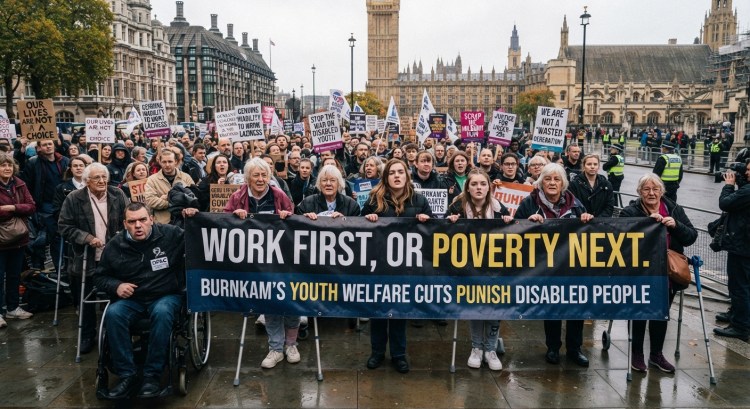
The statement “I don’t want to see anybody in their twenties on benefits in this country,” made by Prime Minister Andy Burnham during PMQs on 21 October 2026, has sparked widespread anger among disability rights advocates who argue that a one-size-fits-all approach pushes young adults with severe disabilities into poverty by ignoring their genuine inability to work.

In response to Prime Minister Andy Burnham’s rhetoric, disability advocacy groups have expressed acute alarm and severe criticism, arguing that cutting benefits for under-25s and limiting free social care to over-65s completely ignores young adults with permanent conditions, risks plunging them into deeper poverty, and fails to provide a fair, comprehensive system for working-age disabled people.

The government’s proposed welfare reforms for under-25s involve completely abolishing the Universal Credit health element and replacing cash benefits with intensive back-to-work schemes, alongside overhauling Personal Independence Payment (PIP) with a separate, tighter regime for youth, though exemptions are planned to protect young people with the most severe and profound disabilities.

While the government’s proposed plan focuses on swapping under-25 cash benefits for intensive back-to-work schemes and overhauling youth PIP, the Conservatives advocate a “tough love” approach that strips Universal Credit from young people without a work history, whereas Reform UK proposes a drastic £50 billion overhaul that restricts disability cash support strictly to the “gravely ill” while moving lower-level conditions entirely to local authority in-kind aid.

Following the publication of the Milburn and Timms reviews in late autumn 2026, the government’s under-25 welfare overhaul is expected to see tighter youth PIP rules apply to new claimants from November 2026, with legislation to replace the Universal Credit health element unveiled after the late 2026 Budget ahead of a full phase-in through 2027 and 2028.

While under current transitional protections, existing under-25 claimants have their Universal Credit health payments temporarily frozen at historical rates rather than immediately cut, ministers are explicitly reviewing whether to retroactively apply the upcoming autumn 2026 Milburn and Timms overhauls to existing recipients rather than limiting the changes to new applicants.

The upcoming Autumn Budget on 28 October 2026 is expected to formalise these decisions by locking in targeted welfare savings to force the Department for Work and Pensions to implement the under-25 Universal Credit cuts and PIP restrictions, thereby directly funding the multi-billion-pound employment and training packages proposed by the Milburn Review.

Chancellor John Healey plans to balance these welfare savings by introducing a “steady as she goes” budget that avoids main tax increases, instead driving revenues through a new tax allowance scheme alongside targeted levies.

Public comments and social media feedback on Prime Minister Andy Burnham’s remarks reveal a deeply polarised response, with critics and disability advocates aggressively condemning the rhetoric as a cruel, out-of-touch threat to vulnerable youth, while some supportive commenters argue that the focus should shift toward fixing an education and mental health system that leaves a “wasted generation” dependent on welfare.

Major UK disability charities have aggressively condemned the youth welfare proposals, with Scope UK warning that cutting Universal Credit will push more young disabled people into poverty rather than jobs, while Contact highlighted that the plans are deeply alarming for families and Sense labelled the cuts as unjust and cruel.

Create your own website, free on WordPress.com.Create your own website.
Start free